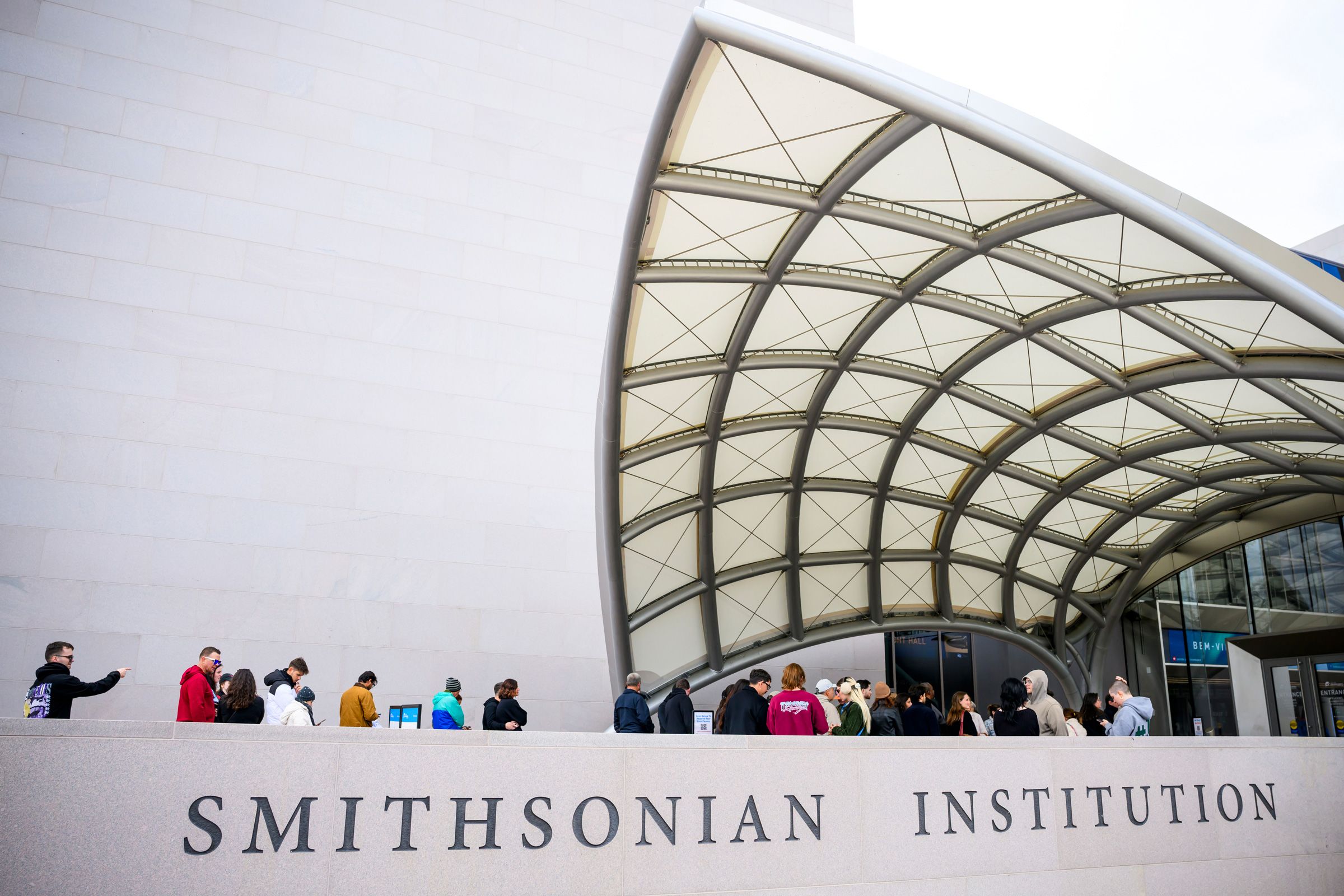
The Smithsonian Institution reached a critical moment as a White House deadline required the submission of thousands of internal documents detailing current and upcoming exhibitions, educational programs, and public events across several of its museums. The request places the institution’s federal funding, valued at more than $1 billion, under heightened scrutiny tied to compliance with a presidential executive order focused on redefining historical narratives presented to the public.
The administration stated that continued access to federal funds depends on whether museum content aligns with standards outlined in Executive Order 14253, which calls for the removal of what it describes as “improper ideology” from federally supported cultural institutions. This requirement introduces a new level of oversight into the operations of an organization that traditionally functions with scholarly independence, as outlined in its governing charter at https://www.si.edu/about.
Federal Funding Conditions and Executive Oversight
The White House formally instructed eight Smithsonian museums to provide detailed records covering exhibit themes, curatorial language, educational framing, and public messaging. Institutions affected by the initial phase include the National Museum of American History, the National Museum of African American History and Culture, the National Air and Space Museum, and the National Museum of the American Indian, all of which operate under the broader Smithsonian umbrella described at https://www.si.edu/museums.
Officials emphasized that funding allocations are contingent upon adherence to executive directives aimed at promoting a positive portrayal of American history. The order asserts that exhibitions should avoid framing American or Western values as inherently oppressive and instead highlight national achievements, civic progress, and historical contributions. The White House maintains that these measures are especially significant as the country approaches the 250th anniversary of its founding.
Governance Structure and Institutional Independence
Despite receiving federal appropriations, the Smithsonian is governed by a board of regents that includes senior judicial and executive branch officials, along with congressional appointees. Operational authority rests with the Secretary of the Smithsonian, Lonnie G. Bunch III, whose role is defined by a balance between academic autonomy and public accountability. Details of this governance structure are outlined at https://www.si.edu/about/leadership.
The request for documentation raises questions about the extent to which federal authorities can influence curatorial decisions without altering the institution’s foundational independence. The Smithsonian’s charter specifies that research, exhibition development, and educational programming should remain free from political direction, a principle that has historically guided its approach to presenting complex historical narratives.
Implications for National Museums and Public History
The review process carries implications beyond the initial group of museums, potentially shaping how future exhibitions are designed across the Smithsonian’s network of 21 museums, 14 education centers, and the National Zoo. Cultural policy observers note that the outcome could establish new precedents for how publicly funded institutions interpret and present national history, particularly during milestone commemorations such as the upcoming semiquincentennial.
As discussions continue, attention remains focused on how the Smithsonian will reconcile federal funding requirements with its long-standing mission to increase and diffuse knowledge. The institution’s educational role, detailed at https://www.si.edu/education, positions it at the center of a broader national debate over historical interpretation, public memory, and the boundaries of governmental oversight.