Russia has temporarily adjusted its military posture toward Ukraine after a direct intervention from U.S. President Donald Trump, marking a rare moment of tactical restraint in a conflict that continues to reshape global security and energy markets. According to statements from Moscow, the Kremlin agreed to suspend attacks on Kyiv until Sunday following a personal request from Trump, a move framed as an effort to create space for diplomatic maneuvering during a period of extreme winter conditions.
The pause comes as Ukraine struggles with freezing temperatures and mounting stress on its energy grid, a sector that has been repeatedly targeted since the beginning of the war. While the suspension does not amount to a formal ceasefire, it signals a narrowly defined shift that could influence short-term dynamics on the battlefield and in negotiations. Analysts following the conflict through institutions such as the International Crisis Group note that even limited pauses can alter strategic calculations when infrastructure vulnerability and civilian resilience are at stake.
A Limited Halt Amid Ongoing Military Pressure
The Kremlin confirmed that the decision to refrain from striking Kyiv was linked specifically to Trump’s request and was intended to foster “favorable conditions” for dialogue. However, Russian officials avoided clarifying whether the pause extends beyond the capital or whether it includes all categories of strikes, particularly those aimed at energy infrastructure. This ambiguity underscores how carefully calibrated the move appears to be.
Ukraine’s air defense systems remained active across multiple regions, as drones and missiles continued to target logistical and military assets elsewhere in the country. Ukrainian authorities emphasized that while Kyiv was spared overnight, other regions remained exposed. According to assessments shared by experts at the Institute for the Study of War, Russia has increasingly diversified its strike patterns, shifting between energy nodes, transport corridors, and urban areas to maintain pressure without committing to full-scale escalation.
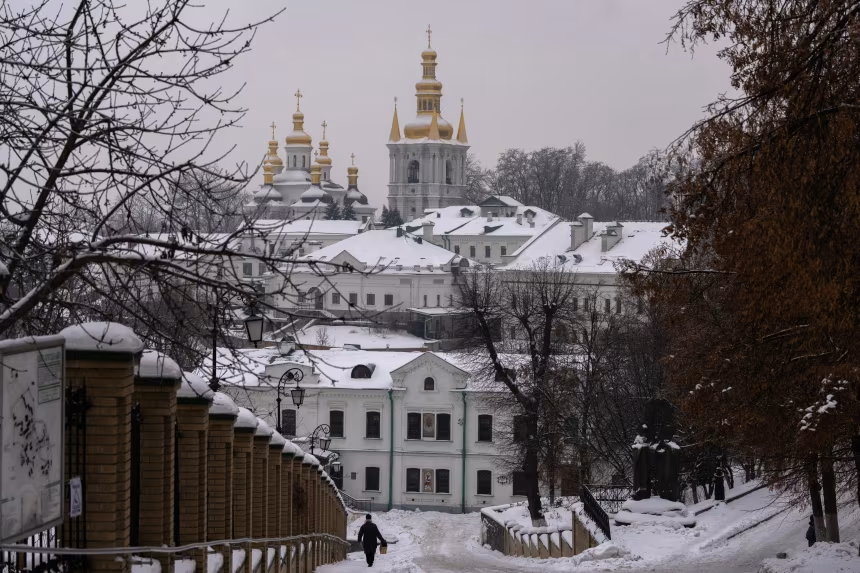
For Kyiv, the absence of strikes on the capital during sub-zero temperatures offers short-term relief but little certainty. Power generation and distribution remain fragile, and repairs often cost hundreds of millions of dollars as systems are repeatedly damaged. Even brief pauses can allow emergency crews to stabilize networks that underpin hospitals, water systems, and heating for millions of residents.
Energy Infrastructure and Strategic Leverage
Ukraine’s leadership framed the pause as an opportunity rather than a binding agreement, signaling caution rooted in past experience. Previous attempts at temporary truces have collapsed amid mutual accusations of violations. Still, Ukrainian officials stated that if Russia refrains from attacking energy facilities, Ukraine would avoid reciprocal strikes on Russian energy assets, a conditional stance that highlights how infrastructure has become a central bargaining chip.
Energy security analysts from the International Energy Agency have warned that sustained damage to Ukraine’s grid could have ripple effects beyond the country’s borders, influencing regional electricity flows and driving up costs tied indirectly to reconstruction and fuel substitution. With repair bills already running into the billions of dollars, even marginal reductions in damage can translate into significant economic impact.
Russia’s campaign against Ukraine’s power system has been one of the most consequential aspects of the war, not only for civilian life but also for industrial output and logistics. By modulating attacks during a critical winter window, Moscow may be testing whether selective restraint yields diplomatic leverage without sacrificing its broader objectives.
Diplomacy, Distrust, and the Path Forward
The reported pause coincides with ongoing discussions involving U.S., Ukrainian, and Russian representatives held in neutral venues, reflecting a renewed—if fragile—push to narrow differences. While Washington has expressed optimism about progress, Russian officials have publicly downplayed expectations, emphasizing that territorial questions and security guarantees remain unresolved.
Foreign policy specialists at the Council on Foreign Relations argue that such tactical pauses often serve dual purposes: easing immediate humanitarian pressure while probing the other side’s willingness to reciprocate. In this case, the absence of strikes on Kyiv could become a test of credibility for both Moscow and Kyiv, especially if the arrangement expires without extension.
As winter deepens, the balance between military pressure and diplomatic signaling will likely intensify. The temporary halt in strikes does not alter the fundamentals of the conflict, but it does illustrate how external political influence, energy vulnerability, and seasonal factors intersect in shaping decisions worth billions of dollars in economic and strategic consequences. Whether this moment evolves into broader de-escalation or fades into another missed opportunity will depend on actions taken long after the pause expires.