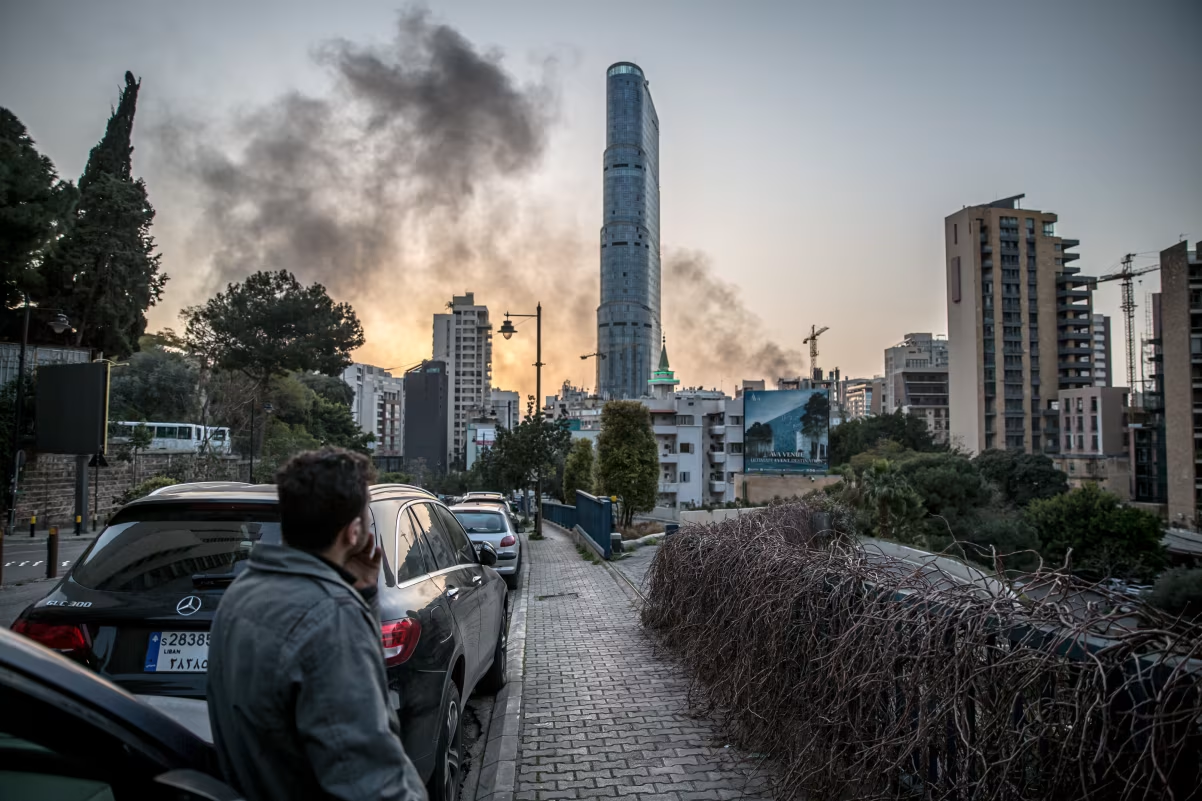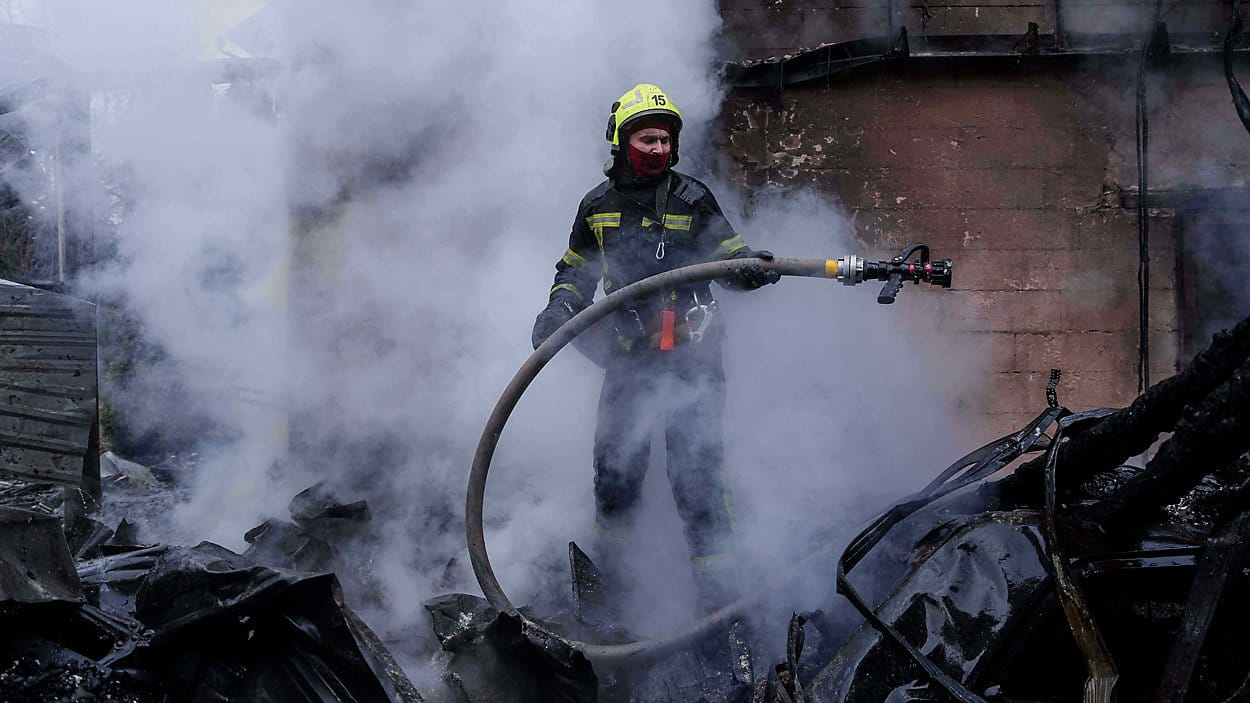
Russia launched a large-scale missile and drone assault on Kyiv just hours before Ukraine and the United States were set to engage in renewed diplomatic talks. These talks aimed at ending the war. The strikes targeted energy systems, residential buildings, and key urban districts. This intensified pressure on Ukraine’s capital at a moment when negotiations over security guarantees and territorial arrangements were gaining momentum.
The attack unfolded overnight and continued into the early morning. It disrupted electricity, heating, and transportation across parts of the city. Kyiv’s infrastructure, already strained by repeated assaults, once again became the focal point. A conflict increasingly blends military escalation with diplomatic maneuvering.
Escalation in Kyiv amid diplomatic pressure
The timing of the attack underscored the fragile balance between warfare and negotiations. As Ukraine prepares to discuss future security guarantees with Washington, Russia’s military actions signal continued resistance. They resist compromise on territorial control and strategic leverage.
Kyiv’s energy infrastructure remains a critical vulnerability. According to data outlined by the International Energy Agency at https://www.iea.org, attacks on power generation and transmission systems can have cascading economic effects. They disrupt industrial output and civilian life. Additionally, they increase reconstruction costs, now running into hundreds of billions of dollars.
Urban districts across Kyiv experienced fires, structural collapses, and emergency evacuations. Residential damage further compounds Ukraine’s housing challenges. The United Nations Development Programme notes at https://www.undp.org that these challenges have already displaced millions. They created long-term reconstruction demands exceeding $400 billion.
Missiles, drones, and the energy battlefield
Modern warfare in Ukraine has increasingly focused on energy dominance. Missile systems and long-range drones have been used not only to weaken military capacity but also to undermine civilian morale. They cut access to heat, electricity, and water during critical periods.
Energy analysts at the World Bank, whose assessments are available at https://www.worldbank.org, emphasize that sustained attacks on infrastructure dramatically increase post-war recovery costs. They delay economic stabilization. In Ukraine’s case, energy disruptions ripple into manufacturing, agriculture, and digital services. They amplify losses measured in tens of billions of dollars annually.
As Kyiv restores damaged systems, international partners continue to provide financial and technical assistance. However, repeated strikes complicate long-term planning and reinforce Ukraine’s demand for enforceable security guarantees as part of any peace framework.
Security guarantees and unresolved territorial disputes
Diplomatic discussions between Ukraine and the United States are expected to focus on security mechanisms. These are modeled on collective defense principles, as well as unresolved territorial issues in eastern and southern regions. These talks aim to establish deterrence structures that would reduce the likelihood of renewed large-scale attacks.
Territorial negotiations remain particularly sensitive. Regions with industrial assets, transport corridors, and energy facilities represent both economic value and strategic depth. According to analysis from the Council on Foreign Relations at https://www.cfr.org, unresolved territorial disputes significantly increase the risk of frozen conflicts. These conflicts could evolve into renewed hostilities.
Ukraine has consistently argued that any settlement must preserve sovereignty while ensuring long-term economic recovery. This includes rebuilding energy systems, restoring housing, and attracting foreign investment. These objectives remain difficult while missile and drone attacks continue to threaten major cities like Kyiv.
As diplomatic talks advance, the situation on the ground illustrates the stark reality facing negotiators. Progress at the table unfolds alongside destruction in the streets. The outcome of these discussions will shape not only the future of Ukraine’s security but also the broader stability of Europe’s geopolitical and economic landscape.