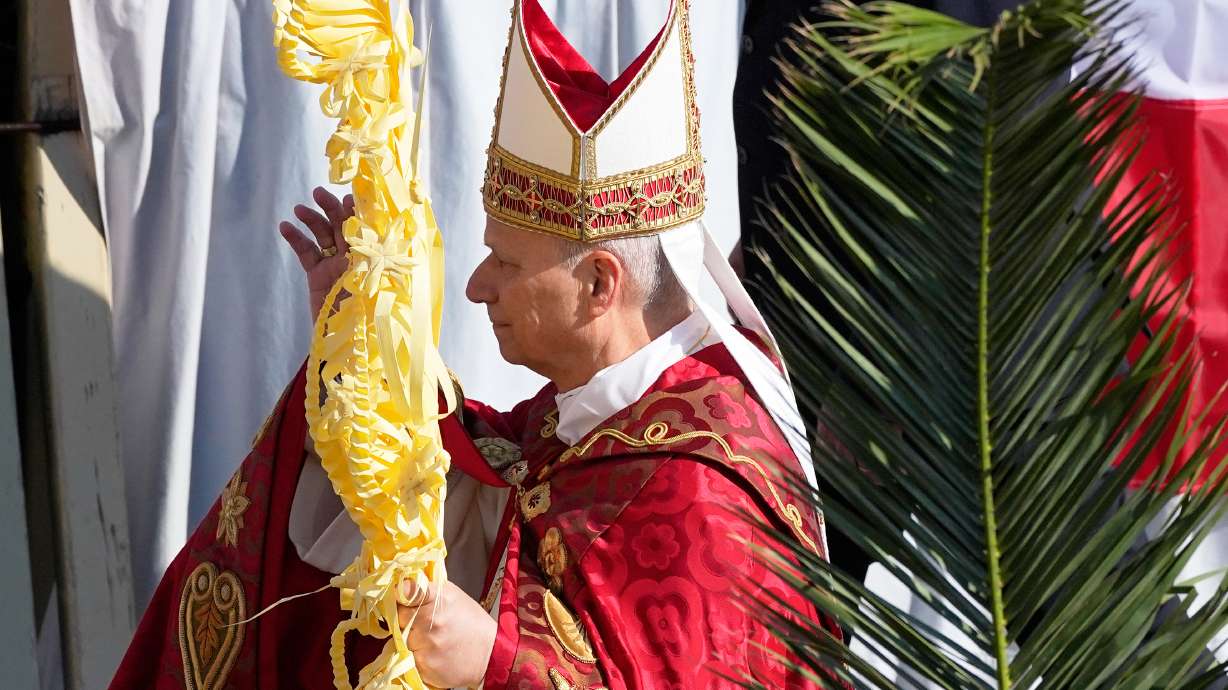
During a solemn Palm Sunday Mass at St. Peter’s Square, Pope Leo XIV delivered a strong message rejecting the notion that war can ever be justified in the name of God. Addressing tens of thousands gathered in Vatican City, the pontiff emphasized that faith must not be used to legitimize violence, especially amid ongoing global conflicts.
The address comes at a time of heightened international tensions, including the war involving Israel and Iran and the continued conflict linked to Ukraine. In this context, the pope’s message sought to reaffirm the role of religion as a force for peace rather than division.
A Clear Rejection of War in God’s Name
In his homily, Pope Leo XIV described God as the “king of peace,” explicitly rejecting any interpretation that frames war as divinely sanctioned. He stressed that invoking religion to justify violence contradicts the core teachings of Christianity.
The message aligns with longstanding positions of the Catholic Church on peace and conflict, which can be further explored through official Vatican teachings at <a href="/es/”https://www.vatican.va”/">Vatican.va</a> and doctrinal explanations on <a href="/es/”https://www.usccb.org”/">United States Conference of Catholic Bishops</a>.
By addressing the issue directly, the pope highlighted the dangers of religious rhetoric being used to support geopolitical agendas, reinforcing the idea that spiritual leadership should guide toward reconciliation and compassion.
Focus on Global Conflicts and Human Suffering
The Palm Sunday address also included prayers for communities affected by violence, particularly Christians in the Middle East. The pope acknowledged the ongoing suffering caused by conflicts and called for solidarity with those living under conditions of instability and fear.
The war involving Israel and Iran, along with the prolonged crisis in Ukraine, reflects a broader pattern of geopolitical tensions that continue to shape international relations. Updates and humanitarian perspectives on these conflicts are regularly covered by organizations such as <a href="/es/”https://www.icrc.org”/">International Committee of the Red Cross</a> y <a href="/es/”https://www.un.org”/">United Nations</a>.
By referencing these crises, the pope placed his message within a global framework, emphasizing that the call for peace extends beyond any single region or conflict.
Religion as a Call to Peace and Unity
Palm Sunday, which marks the beginning of Holy Week, is traditionally a moment of reflection on humility and sacrifice. In this context, Pope Leo XIV used the occasion to underscore the responsibility of believers to reject violence and promote unity.
He warned against the misuse of faith as a political tool and reiterated that true religious practice involves standing with the oppressed rather than endorsing conflict. The message serves as a reminder of the ethical responsibilities tied to spiritual belief, particularly during times of global instability.
As conflicts continue to evolve, the pope’s remarks contribute to ongoing discussions about the role of religion in public life, offering a perspective centered on peace, dignity, and the rejection of war as a solution to human conflict.