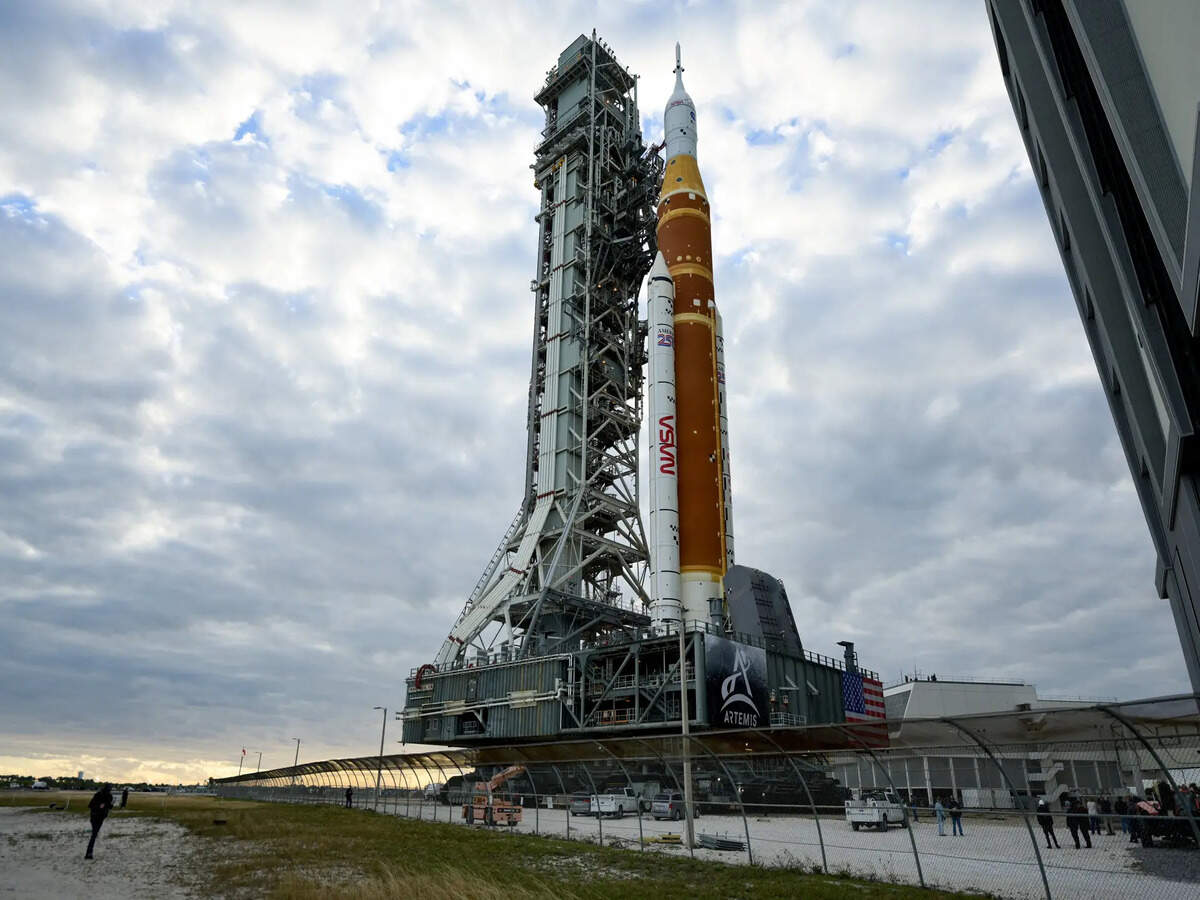
NASA has reached a critical milestone in its return-to-the-moon strategy with the rollout of the Artemis II spacecraft, marking the agency’s most significant step toward a crewed lunar mission in more than five decades. The fully integrated Space Launch System rocket and Orion spacecraft began their carefully planned transfer from the Vehicle Assembly Building to Launch Pad 39B at Kennedy Space Center, initiating a process that reflects years of engineering development and operational coordination.
The massive rocket stack, weighing approximately $11,000,000 pounds, traveled roughly four miles during a journey expected to last up to 12 hours. This rollout places Artemis II firmly on the path toward launch readiness, with mission teams continuing final evaluations to confirm vehicle performance, crew safety, and systems reliability ahead of the targeted launch window as early as February 6.
A Crewed Mission Designed to Validate Deep-Space Systems
Artemis II is designed to carry four astronauts on a multi-day mission that will orbit Earth before extending into a lunar flyby, ultimately looping around the moon and returning safely to Earth. The crew includes NASA astronauts Christina Koch, Victor Glover, and Reid Wiseman, along with Canadian Space Agency astronaut Jeremy Hansen, highlighting the program’s international cooperation and shared exploration goals.
During the approximately 10-day journey, the crew will test Orion’s life-support systems, navigation capabilities, and communications in deep space. These evaluations are essential for validating the spacecraft’s performance beyond low Earth orbit, where future missions will require greater autonomy and resilience. According to NASA, the mission builds directly on lessons learned from the uncrewed Artemis I flight conducted in 2022, which successfully demonstrated Orion’s ability to travel to lunar distances and return.
More information about Orion’s role within the program can be found on the official NASA Orion spacecraft overview at https://www.nasa.gov/humans-in-space/orion.
The Role of SLS in NASA’s Long-Term Lunar Strategy
The Space Launch System remains a central component of NASA’s exploration architecture, providing the heavy-lift capability required for crewed lunar missions. Standing taller than the Statue of Liberty and delivering unmatched payload capacity, SLS enables the transport of astronauts, life-support systems, and mission-critical hardware beyond Earth orbit.
NASA leadership has emphasized that Artemis II is not only about reaching the moon but about refining a transportation system capable of supporting sustainable exploration. As missions progress, the agency expects the architecture to evolve, incorporating new technologies and operational efficiencies that can reduce costs while increasing mission frequency. Detailed technical information about the rocket is available through NASA’s SLS program page at https://www.nasa.gov/exploration/systems/sls.
Artemis Program Goals Extend Beyond the Moon
The Artemis program represents a long-term strategy aimed at establishing a sustained human presence on the moon while laying the groundwork for eventual missions to Mars. Artemis II serves as a bridge between initial test flights and future lunar landings, where astronauts will operate on the surface and conduct scientific research.
Beyond exploration, the mission is expected to generate scientific data that informs radiation exposure management, spacecraft durability, and human performance in deep space. These findings will support not only NASA-led missions but also partnerships with international agencies and commercial space companies. The broader Artemis framework, including plans for the lunar Gateway, is outlined at https://www.nasa.gov/artemis.
International collaboration remains a defining feature of the program, with partners contributing expertise, technology, and astronauts. The Canadian Space Agency’s participation in Artemis II reflects this cooperative approach, reinforcing shared objectives in lunar exploration and beyond. Additional information on international partnerships can be found at https://www.asc-csa.gc.ca/eng.
As Artemis II moves closer to launch, the mission stands as a pivotal demonstration of human readiness to return to deep space, signaling a renewed era of crewed exploration that extends well beyond Earth orbit and toward the future of interplanetary travel.