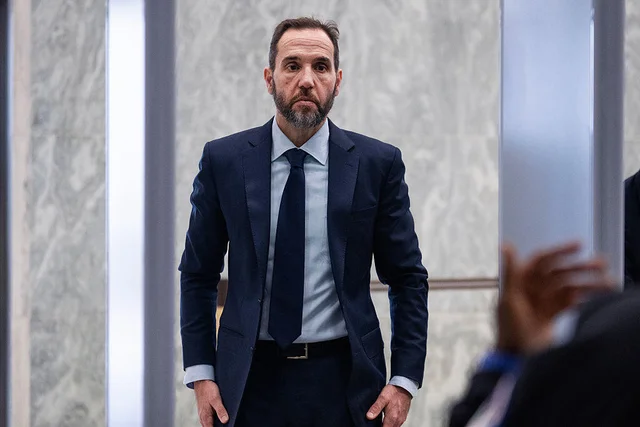
Jack Smith, the former special counsel appointed by the U.S. Department of Justice, defended his investigations into President Donald Trump during a closed-door appearance before the House Judiciary Committee, asserting that every prosecutorial decision he made was grounded exclusively in evidence and the rule of law. According to his prepared remarks, Smith emphasized that political affiliation, public office, or electoral considerations played no role in his judgment, stating that his actions were consistent with long-standing Justice Department standards and prosecutorial independence. His testimony came amid renewed scrutiny of the investigations following Trump’s return to the White House after the 2024 presidential election.
Smith told lawmakers that his office assembled proof beyond a reasonable doubt that Trump participated in a criminal scheme aimed at overturning the results of the 2020 presidential election. He also maintained that investigators uncovered powerful evidence showing that Trump willfully retained classified materials after leaving office and took steps to obstruct efforts to recover them. These determinations, Smith said, reflected the same legal framework applied in other high-profile federal cases and were not influenced by Trump’s political status or campaign activities. The Justice Department’s structure and mission, outlined at https://www.justice.gov, require prosecutors to pursue cases based on facts and law rather than public pressure or partisan considerations.
Prosecutorial Decisions and Legal Standards
In his remarks, Smith underscored that the decision to bring charges rested solely with him as special counsel, but that the factual basis for those charges derived from Trump’s own conduct. He explained that the evidentiary record included witness testimony, documentary evidence, and corroborating materials that met the threshold required for federal criminal prosecution. Smith noted that the Justice Department’s charging principles, which are publicly available through resources such as https://www.justice.gov/jm/justice-manual, guided each step of the investigative process. He stressed that those principles apply uniformly, whether the subject is a private citizen or a former president.
Smith also addressed accusations from Trump and some Republican lawmakers that the investigations were politically motivated. He rejected those claims, stating that if faced with the same facts today, he would make the same prosecutorial decisions regardless of whether the individual involved was a Republican or a Democrat. This assertion, he said, was essential to maintaining public trust in the federal justice system and preserving the integrity of future prosecutions involving senior government officials.
Congressional Scrutiny and Closed-Door Testimony
The closed-door appearance occurred after the House Judiciary Committee issued a subpoena, declining Smith’s earlier offer to testify publicly about his work. While the session was private, Smith used the opportunity to respond to what he described as mischaracterizations of his office’s actions, including criticism related to investigative steps taken during the probes. Among the issues raised was the lawful acquisition of phone records connected to certain members of Congress, which Smith’s team pursued as part of broader investigative leads consistent with federal procedure and oversight rules outlined at https://www.congress.gov.
Despite the committee’s interest in the details of the investigations, Smith was constrained by longstanding secrecy rules governing grand jury proceedings. He explained that federal law strictly limits what prosecutors can disclose regarding grand jury materials, a safeguard designed to protect the rights of witnesses and the integrity of the judicial process. Information about these protections is detailed in federal court guidance available at https://www.uscourts.gov.
Aftermath of the Indictments and Case Outcomes
Smith’s investigations resulted in two separate federal indictments against Trump: one related to efforts to overturn the 2020 election and another focused on alleged obstruction of justice and mishandling of classified documents. Following Trump’s victory in the 2024 election, the Justice Department moved to dismiss the election-related case and ended its appeal of a federal judge’s dismissal of the classified documents prosecution. Smith acknowledged these outcomes while reiterating that prosecutorial decisions must be evaluated based on the evidence available at the time charges are brought, not on subsequent political developments.
Throughout his testimony, Smith framed his work as part of a broader commitment to uphold the rule of law and ensure accountability at the highest levels of government. He emphasized that the independence of federal prosecutors remains a cornerstone of the U.S. legal system, particularly in cases involving former presidents and national security matters. By defending his actions before Congress, Smith sought to reaffirm that principle and clarify the legal reasoning behind some of the most consequential investigations in recent American political history.