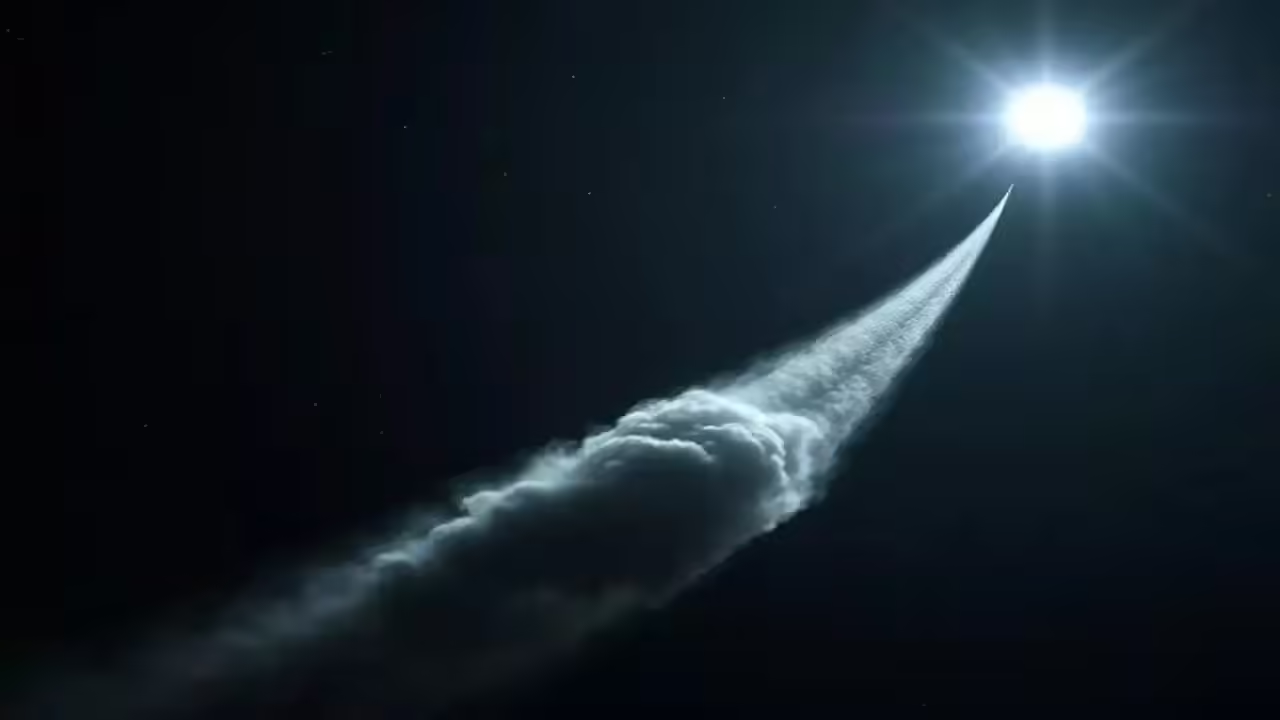
A Rare Visitor From Beyond the Solar System
The interstellar comet 3I/ATLAS is drawing global attention as it travels through our solar system on a long and unusual trajectory. Unlike typical comets that originate from the Kuiper Belt or Oort Cloud, this object arrived from another star system entirely, making it only the third confirmed interstellar object ever detected. Its unexpected path offers researchers an exceptional opportunity to analyze material formed around distant stars, expanding current understanding of planetary evolution beyond our own sun.
Scientists continue examining its composition, acceleration patterns, and interaction with solar radiation, contrasting its behavior with known comets such as the well-studied bodies referenced in the NASA Solar System Exploration database. These comparisons provide essential clues about how planetary systems develop in far-off regions of the galaxy.
Alien Speculation and Why Public Curiosity Keeps Growing
Whenever an interstellar visitor enters our solar system, conversations about extraterrestrial origins inevitably rise. The discovery of 3I/ATLAS has reignited popular interest in the possibility that such objects might exhibit unusual characteristics hinting at advanced technology. Astronomers emphasize that natural processes are far more likely, yet the object’s distant birthplace and rare arrival make it a compelling subject for public imagination.
Discussions about acceleration, structure, and behavior often lead enthusiasts to revisit other interstellar discoveries cataloged by institutions like the European Space Agency, where observational archives help contextualize these exceptional events. Although experts overwhelmingly agree there is no evidence suggesting engineered origins, the combination of mystery and scientific intrigue continues to fuel speculation.
A Unique Opportunity for Scientific Discovery
Comet 3I/ATLAS provides an invaluable chance for astronomers to study raw material that formed around stars light-years away. By observing its chemical components and dust emissions, researchers can contrast foreign planetary elements with those found within our solar neighborhood. These insights contribute to broader studies conducted by initiatives such as NOIRLab, which focus on deep-space chemistry and stellar formation.
The comet’s presence also underscores the importance of ongoing detection programs that track objects on unusual inbound paths. Systems like those described by the International Astronomical Union help researchers identify potential interstellar arrivals early enough to study them in detail. The appearance of 3I/ATLAS reaffirms that interstellar bodies are not just theoretical possibilities but real fragments of distant worlds drifting through space, offering a scientific window rarely available within a human lifetime.