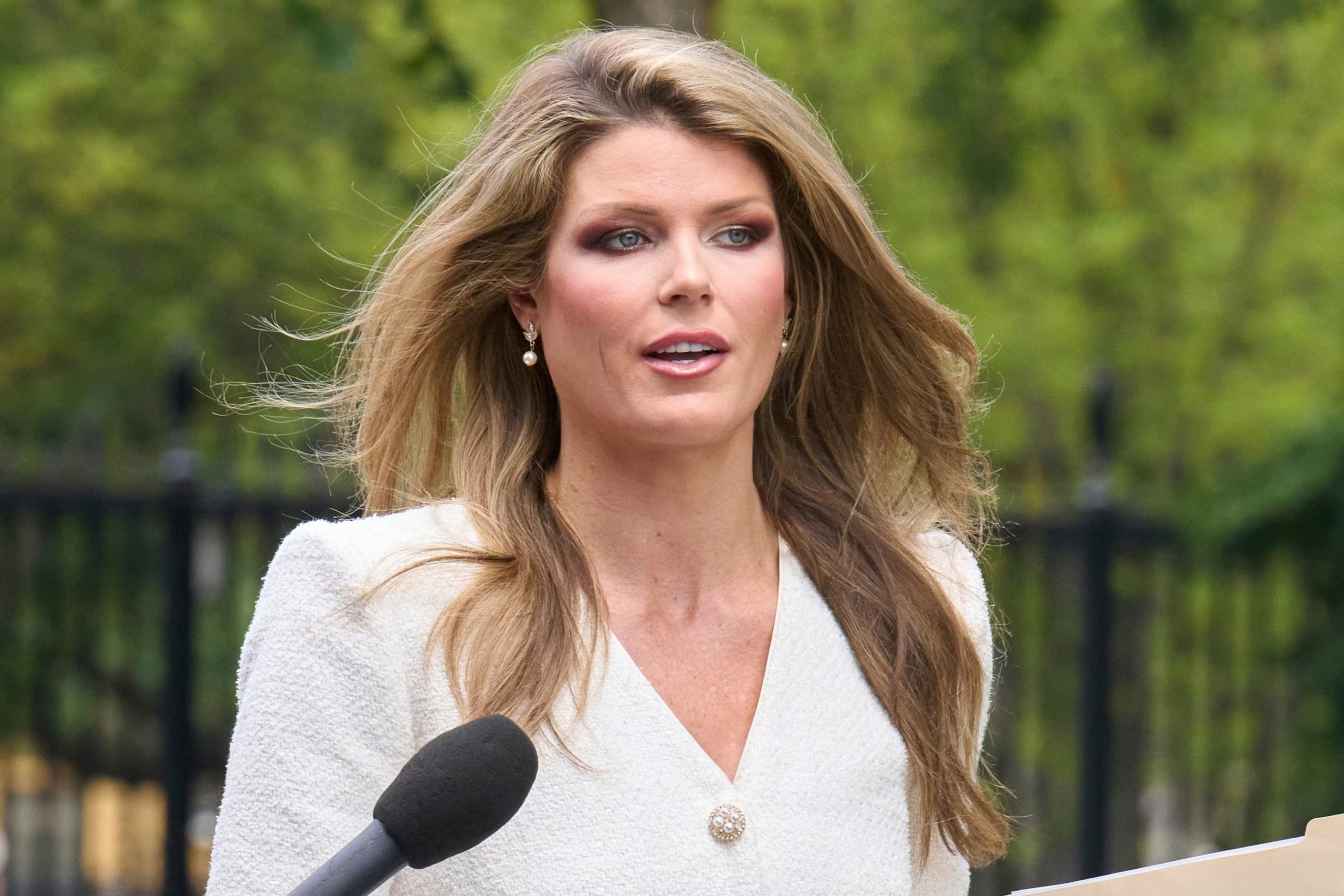
Halligan’s Appointment Sparks a Legal Clash Over Federal Authority
A federal judge has dismissed the Justice Department’s recent cases against former FBI Director James Comey and New York Attorney General Letitia James after concluding that the prosecutor overseeing both matters, Lindsey Halligan, lacked lawful authority to act in her role. The decision has ignited an intensified debate surrounding how federal vacancies should be filled and whether the administration adhered to statutory limits governing interim appointments. The judge emphasized that the federal statute capping interim U.S. attorneys’ service at 120 days was exceeded because the prior acting official had already surpassed that limit, leaving only district courts — not executive officials — with authority to designate a replacement. This legal interpretation has implications beyond the immediate cases and points to broader questions about the boundaries of executive power. Additional context about how federal appointments operate can be explored on resources like whitehouse.gov, which provides information on the executive branch’s structure and processes.
A Rapid Rise From Insurance Law to High-Level Government Roles
Halligan, a 36-year-old former insurance attorney, has drawn national attention for her swift ascent within political and legal circles. Raised in Colorado and recognized early for her academic and extracurricular involvement, she pursued studies in politics and journalism before earning a law degree and beginning a career in insurance defense litigation. Her work included complex property-damage claims and high-value civil disputes, ultimately leading her to partnership at a major Florida law firm. As her profile grew, Halligan became a fixture in conservative legal circles and later formed close ties with Trump after attending an event at his golf club in West Palm Beach. Her reflections on previous work — including time spent at the Miami Innocence Clinic — have shaped her view of defendants’ rights and legal fairness, prompting her to take on increasingly visible responsibilities. More detailed information on federal court systems can be found at uscourts.gov, which outlines how grand juries and federal litigation operate.
Her transition from private practice to public service accelerated when she joined Trump’s legal team in 2022, defending him in high-profile matters including investigations into classified documents. Following Trump’s return to the White House, she took on expanded duties as a senior associate staff secretary and special assistant to the president. As part of her work, she also contributed to the administration’s review of exhibits across major Smithsonian museums, a decision that sparked extensive debate in academic and cultural communities. The Smithsonian’s broader mission, including its educational scope, is well-documented on si.edu, offering insight into how museum content evolves through political and administrative cycles.
Legal Missteps and Mounting Questions Surround Halligan’s Handling of the Cases
Despite the procedural grounds on which the Comey and James cases were dismissed, Halligan’s performance has attracted further scrutiny. Attorneys involved in the cases and outside legal experts have raised concerns about how key steps were conducted during grand jury proceedings, with particular attention to the sequence of indictments and the absence of grand jury review of the final charging documents. These procedural concerns highlight the essential role of prosecutorial experience in managing complex federal cases. Several analysts have noted that handling such cases requires precision, especially when navigating statutes of limitations, grand jury protocols, and evidentiary standards. Guidance regarding prosecutorial standards can be explored in greater depth on justice.gov, where federal procedures and responsibilities are outlined.
Questions intensified after Halligan acknowledged in a hearing that the full grand jury never examined the final indictment presented against Comey. While the Justice Department has downplayed this omission as a clerical oversight, the revelation adds another layer to the ongoing debate over the reliability and legality of the process. Beyond procedural critiques, some have argued that accelerating politically sensitive cases within days of assuming office contributed to the errors now under examination. As the legal and political implications continue to unfold, the administration has signaled its intention to appeal the ruling that voided Halligan’s authority, maintaining that the appointment complied with statutory requirements.