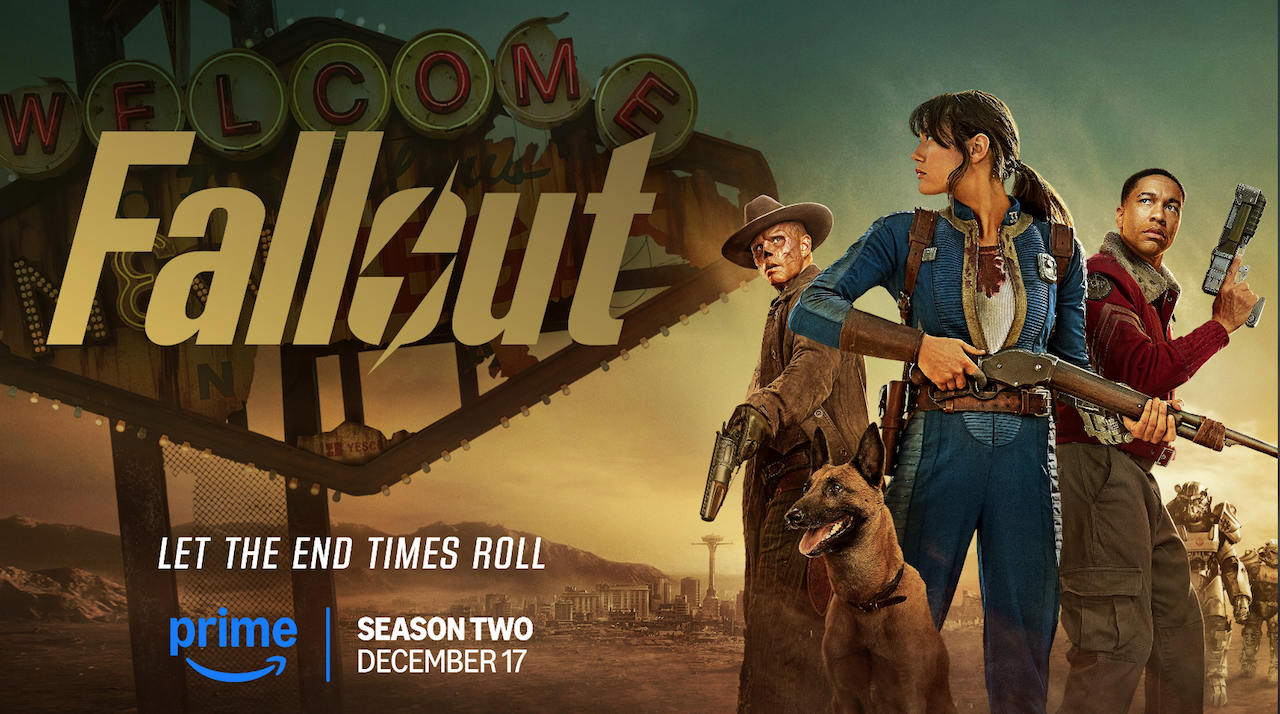
Fallout continues its run on Prime Video with a second season that leans fully into the unsettling balance between bleakness and humor that has defined the franchise for decades. Adapted from the globally recognized video game series developed by Bethesda, the show embraces a vision of a post-nuclear America shaped by violence, survival, and deeply ironic social structures. Rather than softening its tone for a television audience, the series doubles down on its stark contrasts, presenting a world that is simultaneously horrifying and absurd.
The narrative once again follows Lucy, portrayed by Ella Purnell, whose journey from the safety of an underground vault into the irradiated wasteland serves as the emotional and thematic anchor of the story. Her optimism collides with a reality ruled by cruelty, shifting alliances, and moral ambiguity. As the second season unfolds, the show broadens its scope, exploring new factions, power struggles, and the consequences of long-buried decisions that continue to shape the surface world.
A Post-Apocalyptic America Defined by Power and Survival
The America depicted in Fallout is not merely a backdrop for action but a complex ecosystem of competing ideologies. Vault dwellers, mercenaries, mutated survivors, and authoritarian groups all vie for dominance, each convinced of their own version of order. The second season intensifies these conflicts, illustrating how scarcity and fear drive societies toward extremes.
The series’ production design reinforces this vision, blending retro-futuristic aesthetics with decaying landscapes. This visual identity mirrors themes found in the original game franchise, which can be explored further through the official Fallout universe overview at https://fallout.bethesda.net. By maintaining consistency with the source material, the show appeals to longtime fans while remaining accessible to new viewers unfamiliar with the games.
Dark Comedy as a Narrative Weapon
One of Fallout’s defining traits is its use of humor as a survival mechanism. The second season sharpens its satirical edge, using irony and exaggerated violence to critique consumerism, blind optimism, and institutional control. Characters often face grotesque situations with deadpan reactions, reinforcing the idea that laughter persists even when civilization collapses.
This tonal balance places Fallout within a broader trend of genre storytelling that blends dystopia with satire. Streaming platforms have increasingly embraced such narratives, and Prime Video has positioned the series as a flagship title within its original programming lineup, detailed at https://www.primevideo.com. The show’s willingness to be uncomfortable, irreverent, and emotionally raw sets it apart in a crowded market of post-apocalyptic dramas.
Expanding Characters and Moral Complexity
Season two places greater emphasis on character development, particularly as Lucy’s worldview evolves. Her initial hopefulness is tested not only by physical danger but by ethical dilemmas that challenge her understanding of right and wrong. Supporting characters are also given more narrative weight, revealing personal histories shaped by the fallout—both literal and metaphorical—of nuclear devastation.
The performances anchor the series’ emotional impact, allowing the audience to connect with characters navigating a morally fractured world. This approach reflects a broader shift in television adaptations of video games, which increasingly prioritize character-driven storytelling. Industry analysis on this trend can be found through resources like https://www.hollywoodreporter.com, which tracks the growing influence of game-based narratives in serialized television.
As Fallout moves forward, its second season reinforces the idea that the end of the world does not erase human flaws—it amplifies them. By combining sharp writing, stylized violence, and a uniquely dark sense of humor, the series continues to carve out its own space within contemporary television. Its success also underscores the enduring appeal of the Fallout brand, whose cultural impact extends beyond gaming and into mainstream entertainment, as reflected in broader franchise discussions at https://www.imdb.com.