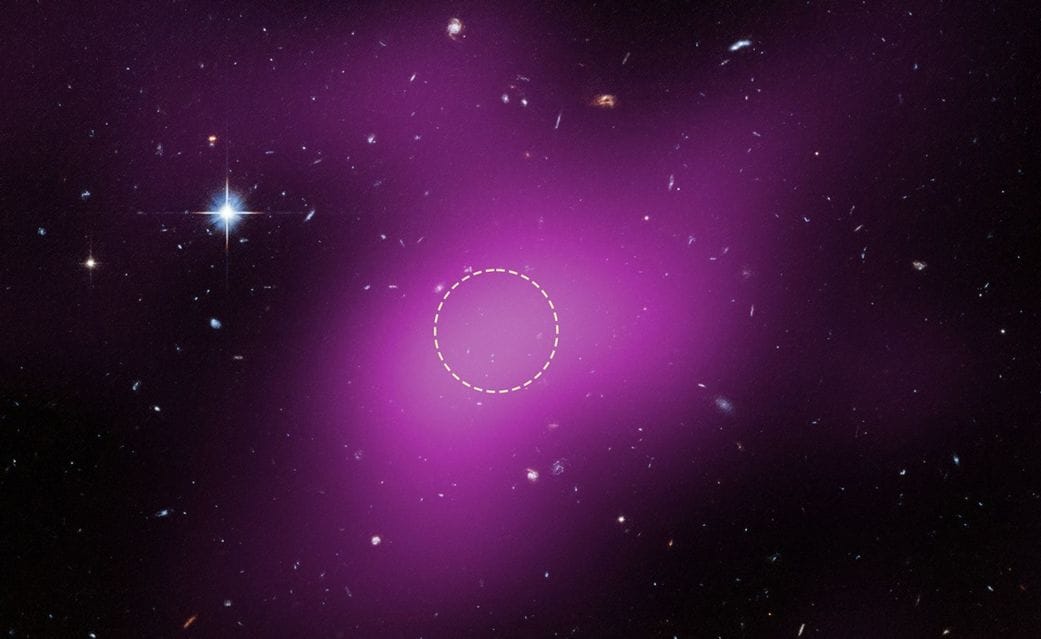
A Failed Galaxy That Defies Conventional Cosmic Evolution
Astronomers have identified a remarkable cosmic structure known as Cloud 9, a so-called “failed galaxy” that challenges long-standing assumptions about how galaxies form and evolve. Unlike typical galaxies, Cloud 9 contains no visible stars, gas clouds, or luminous matter. Instead, it exists almost entirely as a dense clump of dark matter, technically described as a dark matter halo that never ignited the star-formation processes seen elsewhere in the universe.
What makes Cloud 9 especially intriguing is that it appears to have all the gravitational ingredients required to form a galaxy, yet it never crossed the threshold needed to produce stars. In standard cosmological models, dark matter halos act as the scaffolding around which gas accumulates, cools, and eventually condenses into stars and galaxies. Cloud 9 followed the first step of that process but stalled before the second, leaving behind a pristine laboratory for studying dark matter in isolation.
Researchers believe that this structure could help resolve one of the most persistent mysteries in modern physics: the true nature of dark matter itself. Since dark matter does not emit, absorb, or reflect light, its presence can only be inferred through gravitational effects. A system like Cloud 9, unpolluted by stars or normal matter, provides a rare opportunity to observe dark matter’s behavior without interference. The discovery aligns with ongoing theoretical work from institutions such as NASA, which has long emphasized the importance of dark matter halos in shaping large-scale cosmic structures.
Why Cloud 9 Could Hold Clues to the Dark Matter Puzzle
Dark matter is estimated to make up roughly 85 percent of all matter in the universe, yet scientists still do not know what it is made of. Popular hypotheses range from weakly interacting massive particles to exotic alternatives like axions or modifications to gravity itself. Observations of Cloud 9 could help narrow down these possibilities by revealing how dark matter clusters, how dense it becomes in isolation, and how it interacts gravitationally over billions of years.
Because Cloud 9 never formed stars, its internal structure is expected to be closer to the original configuration of dark matter in the early universe. This makes it a valuable reference point for comparing predictions from simulations with real-world observations. Cosmologists using models based on ΛCDM, the standard framework of cosmology, can test whether their assumptions about dark matter’s properties hold true in such an extreme environment. Data from large surveys coordinated by organizations like ESA may further refine measurements of Cloud 9’s mass distribution and gravitational profile.
Another critical factor is the role of cosmic radiation and environmental conditions. Some researchers suggest that early bursts of radiation or nearby energetic events could have prevented gas from cooling and collapsing into stars within Cloud 9. If confirmed, this would highlight the delicate balance required for galaxy formation and underscore how minor differences in early cosmic conditions can lead to radically different outcomes.
Implications for the Formation of the Universe
The existence of Cloud 9 has profound implications for our understanding of how the universe evolved from a nearly uniform sea of particles into the richly structured cosmos seen today. It suggests that not all dark matter halos inevitably become galaxies, and that a hidden population of failed galaxies may exist throughout the universe, silently tracing the cosmic web.
If more objects like Cloud 9 are identified, they could significantly alter estimates of how much matter is locked away in invisible structures. This, in turn, would influence calculations of the universe’s total mass, its expansion rate, and the dynamics of galaxy clusters. Insights gained from studying these systems could also complement research conducted by institutions such as CERN, where scientists explore fundamental particles that may ultimately explain dark matter’s composition.
Cloud 9 also serves as a reminder that the universe still holds vast, uncharted territories of knowledge. By offering a rare glimpse into dark matter unaccompanied by stars or gas, this failed galaxy could become a cornerstone in efforts to unify cosmology and particle physics. As observational techniques improve and next-generation telescopes come online, Cloud 9 may prove to be the missing piece in a puzzle that has challenged scientists since the earliest days of modern astrophysics.