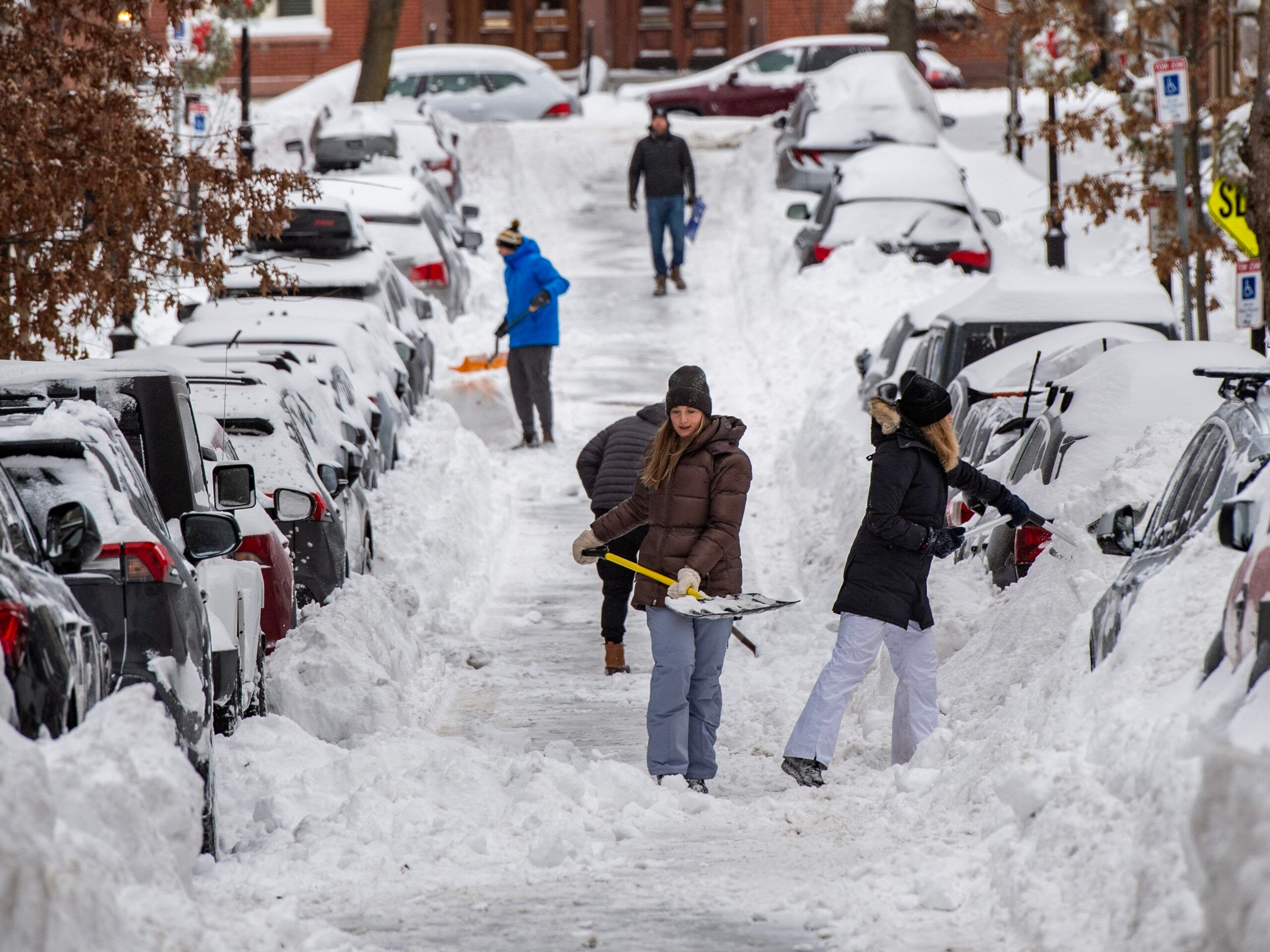
The question of whether drivers can save a public parking spot after digging their car out of deep snow has become one of the most emotionally charged winter controversies in American cities. Each major snowstorm reignites fierce neighborhood disputes, as residents invest hours of labor clearing vehicles only to return and find someone else parked in what they consider “their” hard-earned space. While many see space-saving as a matter of courtesy and fairness, others argue it violates public use laws and undermines the principle of shared urban infrastructure.
In cities where street parking is already scarce, the arrival of heavy snowfall intensifies competition. Drivers often resort to placing household items such as chairs, cones, tables, trash bins, or even decorative objects in the space they cleared, creating makeshift barriers that signal ownership. This informal system, though culturally ingrained in some neighborhoods, often clashes with municipal regulations and sparks disputes that range from heated arguments to vehicle damage and public confrontations.
As winter storms become more unpredictable and intense, the issue of saving public parking spots after a snowstorm has evolved from a quirky urban tradition into a serious policy and public safety concern. Municipal governments now face mounting pressure to clarify legal boundaries, enforce parking laws, and prevent neighborhood tensions from escalating.
The Cultural Roots of Space Saving in Snowy Cities
In historically snowy cities such as Boston, Chicago, and Baltimore, saving a parking space after shoveling has long been seen by some residents as a form of earned privilege. Clearing snow from a car can take hours, particularly after major storms that leave behind thick layers of ice and compacted snow. Many drivers feel that their physical effort grants them temporary priority over the cleared space.
This deeply rooted belief has become part of local winter culture, reinforced by years of shared experience and informal community norms. In Boston, for instance, residents have famously deployed everything from lawn chairs to large figurines to mark their territory, transforming residential streets into surreal displays of domestic creativity. Similar practices appear in Chicago, where the controversial “dibs” tradition has become a recurring source of neighborhood debate.
Despite its cultural acceptance in some areas, this behavior increasingly conflicts with modern urban planning principles. Streets are considered public assets designed for shared use, meaning that no individual can legally claim ownership over a parking space. Municipal authorities argue that allowing space-saving creates barriers to mobility, disrupts traffic flow, and poses risks to pedestrians, cyclists, and emergency vehicles.
Urban policy experts often point out that public streets function as part of a complex transportation network. Blocking access, even temporarily, can affect public transit, snowplow operations, and emergency response times. Cities such as Baltimore and Chicago now emphasize strict enforcement of regulations prohibiting street obstructions, reinforcing the idea that parking spaces belong to the public, not individuals. For broader context on how urban street use is regulated, resources from the U.S. Department of Transportation at https://www.transportation.gov provide detailed insights into federal transportation policies.
Legal Perspectives and City Enforcement Strategies
The legality of saving a public parking spot after a snowstorm depends largely on local ordinances. While some municipalities tolerate temporary space-saving during extreme conditions, others impose fines and penalties for obstructing public roads. In Chicago, the Department of Streets and Sanitation has made it clear that placing objects in the street constitutes illegal dumping, leading to thousands of enforcement actions each winter. More details on Chicago’s street maintenance policies can be found at https://www.chicago.gov/city/en/depts/streets.html.
Baltimore has adopted a similarly strict stance, emphasizing that any object placed in the street is subject to removal. City officials argue that allowing space-saving would create chaos and significantly hinder snow removal efforts. Baltimore’s municipal code, accessible through https://legislativereference.baltimorecity.gov, explicitly prohibits the obstruction of sidewalks and streets, reinforcing the principle of open public access.
Boston occupies a more complex middle ground. While the practice is not formally legalized, local enforcement often varies depending on neighborhood conditions and snowfall severity. This inconsistent approach has fueled confusion and resentment among residents, some of whom view enforcement as arbitrary. City policy updates and winter parking regulations are frequently communicated through official channels such as https://www.boston.gov, though debates persist over whether clearer and stricter rules are necessary.
Urban planners argue that transparent enforcement combined with public education is essential to reducing conflict. By clarifying legal boundaries and promoting cooperative behavior, cities can mitigate tensions and foster a shared understanding of public space responsibilities. Some municipalities are experimenting with digital platforms and mobile alerts to inform residents of parking restrictions, plowing schedules, and snow emergency declarations, aiming to reduce misunderstandings before disputes arise.
Social Tensions, Safety Risks, and the Future of Winter Parking
Beyond legality, the practice of saving parking spots has significant social implications. Neighborhood disputes over parking frequently escalate, particularly after major snowstorms that intensify stress and exhaustion. Reports of vandalism, verbal altercations, and even physical confrontations highlight the emotional stakes attached to winter parking.
From a safety perspective, blocked streets can impede emergency vehicles, delay public transit, and increase the risk of pedestrian accidents. Fire departments and medical responders consistently warn that obstructed access can cost valuable minutes in critical situations. National public safety guidance from organizations such as the Federal Emergency Management Agency, available at https://www.ready.gov, emphasizes the importance of keeping streets and sidewalks clear during extreme weather events.
Looking ahead, climate variability is expected to increase the frequency of severe winter storms in many regions, making parking conflicts a recurring challenge. Urban policymakers are now exploring adaptive strategies, including expanded snow removal services, residential parking permits, and temporary winter parking zones. These measures aim to balance fairness, efficiency, and safety while preserving community harmony.
As cities continue to evolve, the debate over saving public parking spots after a snowstorm reflects broader questions about public space, shared responsibility, and urban resilience. Whether through stricter enforcement or cultural shifts toward collective cooperation, resolving this conflict will require both policy innovation and community engagement. In the meantime, each snowfall serves as a reminder that in dense urban environments, even a single parking spot can become a symbol of much larger social tensions.