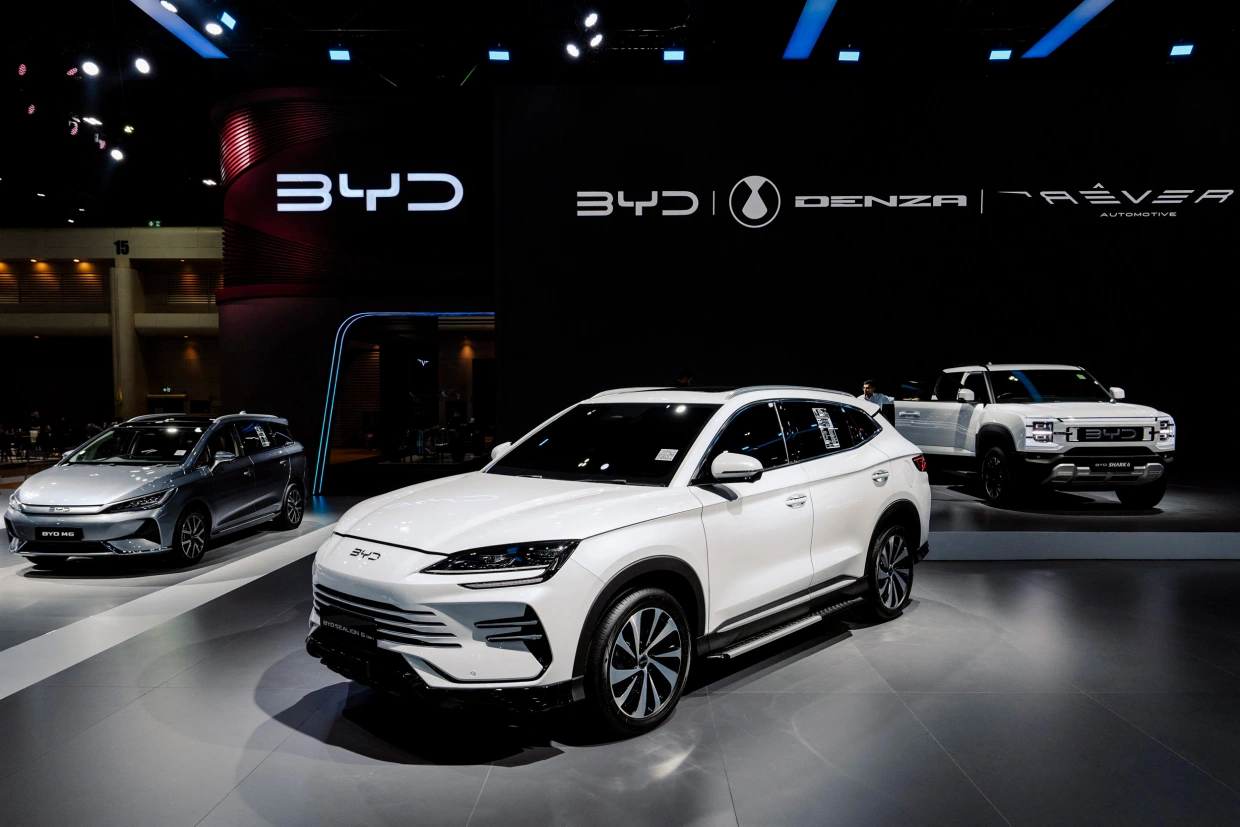
The global electric vehicle market enters 2026 under a dramatically altered hierarchy. China-based BYD has firmly positioned itself ahead of Tesla in worldwide EV sales. This shift reflects more than a single year of strong deliveries; it marks a structural transformation in how electric mobility is being manufactured, priced, and adopted across regions. While Tesla once defined the pace of innovation and growth, the competitive landscape has broadened. This change is driven by aggressive pricing, diversified product portfolios, and expanding infrastructure investments.
BYD’s rise has occurred despite limited access to the United States market. This highlights how scale, vertical integration, and supply-chain control are reshaping global automotive leadership. As EV demand moderates in mature markets and intensifies in emerging ones, 2026 is shaping up to be a decisive year. Manufacturers are attempting to balance profitability with expansion.
BYD’s Scale Advantage Reshapes the EV Market
BYD’s ability to surpass Tesla rests largely on its manufacturing scale and cost discipline. The company controls much of its battery production in-house, allowing tighter margins and greater resilience during price wars. This vertically integrated model has enabled BYD to maintain competitive pricing. They still deliver millions of vehicles annually across Asia, Europe, Latin America, and parts of the Middle East. According to industry benchmarks tracked by organizations such as the International Energy Agency, battery costs remain one of the most decisive factors in EV adoption. BYD’s structure provides a durable edge in that equation
https://www.iea.org
While Tesla continues to focus on software-driven differentiation and long-term bets such as autonomous driving, BYD has emphasized rapid model turnover and practical affordability. This strategy has resonated strongly in markets where EV adoption is driven less by brand prestige. Instead, it is driven more by price sensitivity, charging accessibility, and government incentives. As a result, BYD’s global footprint now spans both premium and mass-market segments. This diversification buffers it from regional slowdowns.
Tesla Faces Pressure from Policy Shifts and Slowing Demand
Tesla’s entry into 2026 is marked by growing strategic pressure. The expiration of consumer tax incentives in key markets has exposed softer underlying demand, particularly in North America and parts of Europe. Although Tesla introduced lower-cost variants of its flagship models, reduced driving range and feature limitations have complicated its value proposition. This is relative to competitors offering similar prices with broader configurations.
In parallel, Tesla’s reliance on a narrower lineup has become more evident as rivals expand aggressively. Analysts tracking global auto trends through platforms like Statista note that EV buyers are increasingly comparing across dozens of brands. They no longer default to a single market leader
https://www.statista.com
Despite these challenges, Tesla remains a dominant force in EV infrastructure, software ecosystems, and brand recognition. Its ambitions in robotics, autonomous transport, and energy storage continue to attract long-term investor interest. However, near-term delivery numbers suggest that market leadership is no longer guaranteed by innovation alone.
Global Competition Intensifies Beyond the US and China
The EV race entering 2026 is no longer defined solely by the US–China rivalry. European automakers are accelerating electrification strategies, while new entrants from Asia continue to challenge established players on cost and speed. Market data tracked by financial platforms such as Bloomberg show that price competition has compressed margins globally. This forces manufacturers to rethink expansion strategies
https://www.bloomberg.com
BYD’s overseas growth strategy reflects this reality. While domestic competition in China remains fierce, international markets offer volume growth and regulatory tailwinds. However, new tariffs and trade restrictions introduce uncertainty, particularly in regions aiming to protect local manufacturing. Meanwhile, Tesla’s global production network provides some insulation, but demand volatility remains a key risk.
As the industry moves deeper into 2026, success will depend less on early-mover advantage and more on execution at scale. Companies that are able to align pricing, technology, and regional policy compliance will shape the next phase of the EV transition. For investors and consumers alike, the era of a single dominant EV king has ended. It is replaced by a fast-evolving contest where leadership is measured quarter by quarter rather than decade by decade.