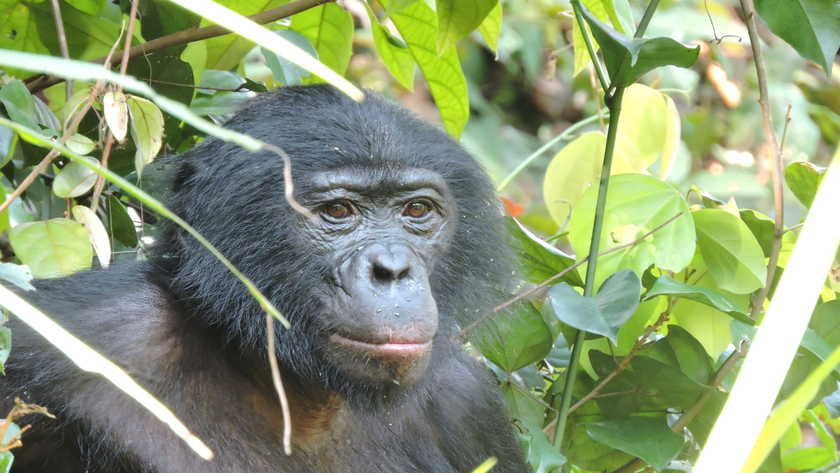
The ability to imagine scenarios that do not exist in the present moment — to engage in make-believe, create fictional situations, and mentally track invisible objects — has long been considered a defining feature of human cognition. From childhood games and imaginary friends to advanced creative thinking and strategic planning, imagination plays a central role in shaping intelligence, empathy, and social behavior. However, a groundbreaking experiment involving a renowned bonobo named Kanzi is challenging that assumption and expanding scientific understanding of animal minds.
Researchers from leading academic institutions designed a series of controlled experiments inspired by developmental psychology studies traditionally conducted with young children. Their findings provide compelling evidence that at least some great apes may possess a form of imagination, suggesting that the roots of this ability could extend back millions of years to a common ancestor shared by humans and bonobos. The research sheds new light on the evolution of cognition and underscores the remarkable complexity of nonhuman intelligence.
A Controlled Experiment That Tested Imagination
Kanzi, one of the world’s most famous bonobos, was raised in a language-rich environment that allowed him to communicate with humans using visual symbols and gestures. His extraordinary capacity for understanding spoken English and responding accurately to questions made him an ideal subject for exploring higher cognitive abilities. Scientists designed experiments modeled on classic child psychology studies, including a symbolic tea party, to test whether Kanzi could mentally track imaginary objects.
During the sessions, researchers placed two transparent, empty cups and a pitcher on a table and pretended to pour juice into both cups. They then mimicked pouring the imaginary liquid from one cup back into the pitcher. At that point, only one cup should still contain the nonexistent juice. When Kanzi was asked to identify where the imaginary juice remained, he consistently pointed to the correct cup, demonstrating the ability to track invisible objects through a series of imagined actions.
This performance closely mirrors the behavior of young children who are able to engage in symbolic thinking and pretend play. According to cognitive scientists at Johns Hopkins University, this capacity suggests that bonobos may possess a foundational form of imagination, reshaping assumptions about the uniqueness of human mental abilities. More about this research context can be found through the work of the university’s cognitive science department at https://www.jhu.edu.
The study was published in a leading scientific journal and has sparked international debate among neuroscientists, psychologists, and evolutionary biologists. By carefully controlling experimental conditions and replicating child-based cognitive tests, researchers were able to isolate imagination as a measurable cognitive process rather than an accidental behavior.
What Bonobos Reveal About Human Evolution
Bonobos share approximately 98.7% of their DNA with humans, making them one of our closest living relatives. This genetic proximity has long fueled scientific interest in their emotional intelligence, social cooperation, and communication skills. The discovery that bonobos may also possess imagination adds a new dimension to evolutionary studies, suggesting that the cognitive foundations of creativity and symbolic thought could predate the emergence of Homo sapiens by millions of years.
Scientists believe that the last common ancestor between humans and bonobos lived between $6 million and $9 million years ago. If this ancestor already possessed basic imaginative capabilities, it could mean that creativity and mental simulation evolved not as uniquely human traits but as survival tools that enhanced problem-solving, cooperation, and adaptability. These findings strengthen the idea that imagination may have played a crucial role in early social bonding, conflict resolution, and planning behaviors.
Research centers such as the Ape Initiative in Iowa, where Kanzi lived, continue to study bonobo cognition to deepen understanding of primate intelligence. Their ongoing work, detailed at https://www.apeinitiative.org, explores communication, memory, empathy, and now imagination, offering invaluable insights into the evolutionary origins of human thought.
Implications for Science, Ethics, and Conservation
The implications of this discovery extend far beyond academic curiosity. If apes possess imaginative abilities, this raises important ethical considerations regarding animal welfare, captivity, and conservation. Recognizing complex mental lives in nonhuman species reinforces arguments for improved living conditions, enriched environments, and stronger protections for endangered primates.
Bonobos are currently classified as endangered due to habitat loss, poaching, and political instability in their native regions of the Democratic Republic of Congo. Understanding their advanced cognitive abilities may help drive global support for conservation initiatives and ethical research practices. Organizations dedicated to wildlife preservation, such as the World Wildlife Fund at https://www.worldwildlife.org, emphasize that scientific discoveries can play a vital role in shaping public awareness and policy.
Furthermore, this research opens new avenues for comparative psychology and neuroscience, prompting scientists to reevaluate how imagination evolved and how it functions across species. The study also complements broader discussions on animal cognition promoted by institutions like Science Magazine at https://www.science.org, where emerging findings continue to challenge conventional definitions of intelligence.
By demonstrating that bonobos can engage in structured pretend play, researchers have taken a significant step toward redefining the boundaries between human and animal cognition. Rather than being an exclusive hallmark of humanity, imagination now appears to be part of a shared evolutionary legacy — one that connects us more deeply than ever to our closest living relatives.
As scientific exploration continues, the story of Kanzi stands as a powerful reminder that the minds of animals may be far richer and more complex than previously imagined, reshaping how humanity understands intelligence, empathy, and the origins of creativity itself.