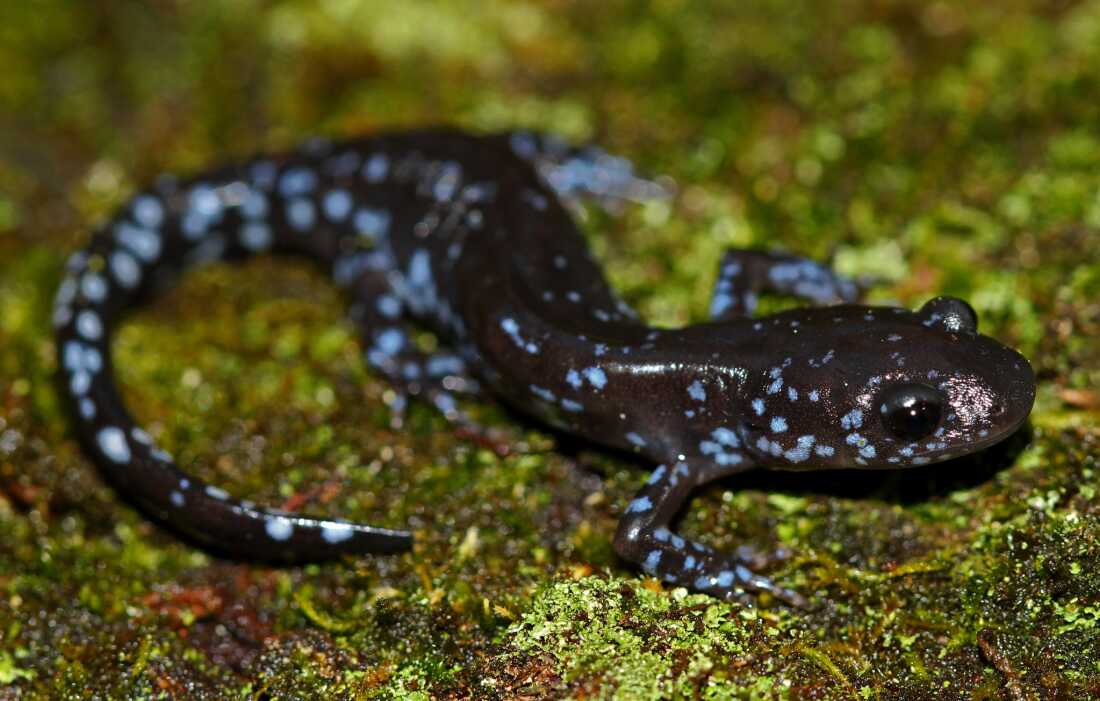
Blue-spotted salamanders are challenging long-standing assumptions about how amphibians survive winter conditions. Despite their moist skin and delicate physiology, these small forest-dwelling creatures are capable of remaining active in subfreezing environments, thanks to a phenomenon known as supercooling. This biological process allows their body fluids to remain liquid even when temperatures fall below the normal freezing point, enabling movement across snow-covered landscapes in late winter.
Observed in northern forest ecosystems, particularly around frozen lakes and wetlands, this behavior highlights an extraordinary adaptation that contrasts with the traditional belief that amphibians must avoid exposure to cold entirely. Instead of remaining dormant underground until spring temperatures rise, blue-spotted salamanders can emerge earlier, gaining critical access to breeding sites before competitors arrive.
Supercooling and Amphibian Physiology
Supercooling occurs when an organism’s body fluids avoid crystallization despite exposure to freezing temperatures. In blue-spotted salamanders, this allows cellular structures to function without ice damage. Unlike freeze-tolerant species that survive by allowing ice to form in controlled areas of the body, supercooled salamanders remain fully unfrozen while still exposed to cold air and snow.
This ability places them among a select group of cold-adapted vertebrates. Amphibian physiology is typically associated with temperature sensitivity, as explained in broader biological overviews such as those available through the Encyclopaedia Britannica’s amphibian section at https://www.britannica.com/animal/amphibian. The salamanders’ capacity to regulate their internal chemistry suggests evolutionary mechanisms that are still not fully understood.
Winter Movement Across Frozen Landscapes
Blue-spotted salamanders inhabit forested regions across the Great Lakes basin, New England, and parts of southern Canada. During late winter, they migrate from underground shelters toward vernal pools and temporary wetlands to begin breeding. In some protected environments like Algonquin Provincial Park, described at https://www.ontarioparks.ca/park/algonquin, salamanders have been seen traversing snow while lakes remain frozen solid.
This movement provides a reproductive advantage. Early arrival at breeding pools allows salamanders to deposit eggs before water levels fluctuate or predators become active. Such behavior underscores the importance of seasonal timing in amphibian survival strategies and reinforces the ecological value of preserving intact forest corridors.
Implications for Climate and Conservation
As climate variability increases, species capable of coping with temperature extremes may gain resilience. Understanding how blue-spotted salamanders survive cold exposure contributes to broader discussions on biodiversity conservation and climate adaptation. Amphibians worldwide are under pressure from habitat loss, disease, and environmental change, as outlined by conservation resources at https://www.nationalgeographic.com/animals/amphibians.
Preserving cold-region wetlands and forest ecosystems remains essential. Public lands and conservation initiatives, including those supported by agencies such as https://parks.canada.ca, play a key role in maintaining habitats where such specialized species can continue to thrive.