The battle for control of the U.S. House of Representatives in 2026 is unfolding in an increasingly narrow electoral landscape. Political analysts project that fewer congressional contests will be genuinely competitive this fall compared with previous election cycles, with redistricting emerging as a central factor reshaping the political map. Out of 435 House districts nationwide, only 18 are currently rated as toss-ups, meaning that less than 5% of districts are expected to determine which party holds the majority.
This sharp decline in competitive seats has major implications for voter influence, campaign spending, and legislative accountability. With more than 90% of races effectively decided during primary elections—where turnout is traditionally far lower than in general elections—the power to shape Congress is shifting toward a smaller and often more ideologically committed segment of the electorate.
Mid-Decade Redistricting Reduces Electoral Competition
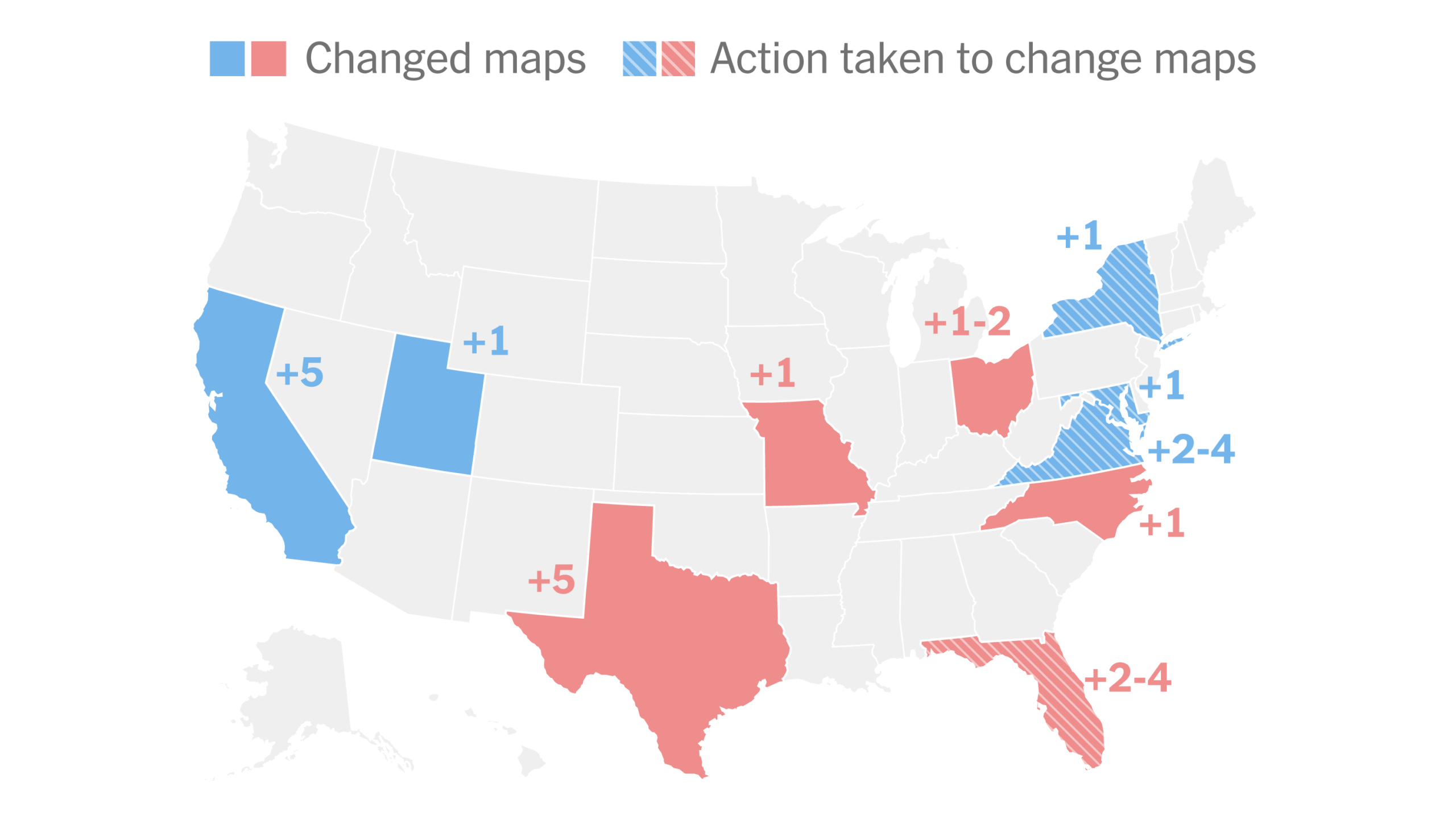
The recent wave of mid-decade redistricting has significantly narrowed the battleground map. In 2025, lawmakers in states including Texas and California redrew congressional districts in ways that strengthened partisan strongholds. In Texas, Republican lawmakers approved new district boundaries aimed at creating five additional seats favorable to the GOP for 2026. In response, Democratic leaders in California advanced a ballot measure that effectively bypassed the state’s independent redistricting commission, reshaping districts to potentially add five Democratic-leaning seats.
Other states, including North Carolina and Missouri, have also implemented new maps, while Florida and Virginia are considering similar adjustments. According to election analysts at https://www.cookpolitical.com, even when including races rated as “leaning” toward one party, only 36 districts—less than 10% of the House—could be considered competitive.
Compared to the same point in the 2018 midterm cycle during the first term of Donald Trump, when 48 districts were viewed as competitive, the 2026 map reflects a notable contraction in the electoral battleground. Experts argue that while the redrawn districts may not yet provide a pronounced advantage to either Republicans or Democrats, they significantly reduce the number of voters who have a meaningful say in determining congressional control.
The Growing Influence of Primary Voters
With the vast majority of House seats effectively safe for one party, primary elections are becoming the decisive stage in congressional contests. However, primary electorates are typically smaller and less representative of the general population. Data compiled by Unite America Institute and available at https://www.uniteamerica.org indicate that in 2024, just 7% of voters effectively decided 87% of House races.
Primary voters tend to be older, wealthier, more educated, and more ideologically engaged than the broader electorate. As a result, candidates often tailor their platforms to appeal to highly partisan voters rather than to moderate or independent constituents. This dynamic can intensify polarization in Washington and make bipartisan compromise more difficult.
Efforts to reform primary systems have gained traction in some states. For example, New Mexico now allows independent voters to participate in party primaries. Conversely, Louisiana and West Virginia have moved to restrict certain primaries to registered party members. Currently, 17 states operate fully or partially closed primary systems, limiting participation by unaffiliated voters. Information on voter registration rules and primary systems can be accessed through https://www.ncsl.org.
Geographic Sorting and the Technology of Mapmaking
Beyond legislative decisions, demographic trends and technological advances have also played a role in diminishing competition. Voters have increasingly clustered geographically by political preference, creating naturally safer districts. At the same time, sophisticated mapping software and detailed voter data have enabled lawmakers to draw district lines with unprecedented precision.
This combination of self-sorting and targeted redistricting has produced congressional delegations that are more ideologically uniform within states. Blue states are sending increasingly Democratic delegations to Washington, while red states are solidifying Republican majorities. The result is fewer crossover districts and fewer lawmakers incentivized to appeal to bipartisan coalitions.
Organizations such as https://www.brennancenter.org continue to track redistricting practices and their impact on electoral fairness, warning that diminished competition can weaken democratic accountability. As the 2026 midterm elections approach, analysts suggest that regardless of which party ultimately secures the majority, the shrinking number of competitive districts signals a structural shift in American politics—one in which primary voters wield disproportionate influence and general election campaigns play a diminishing role in determining congressional power.