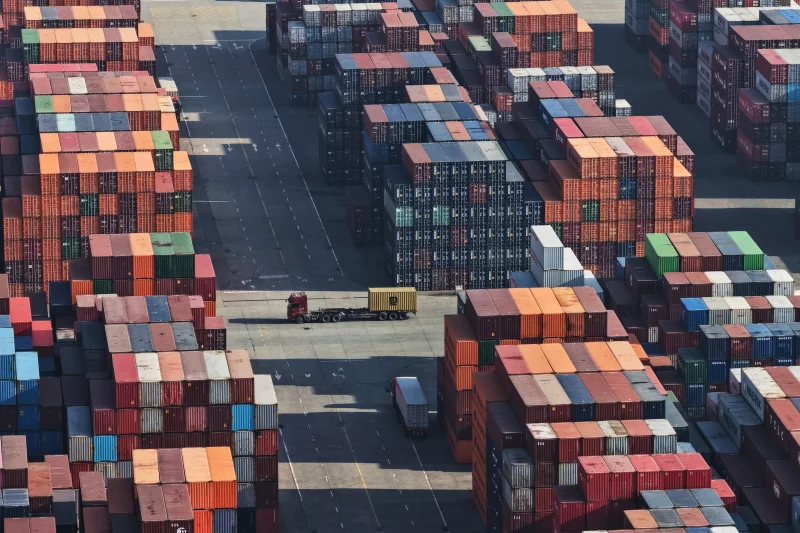
China’s external trade performance reached an unprecedented level in 2025, with the country recording a trade surplus exceeding $1.2 trillion, underscoring the resilience of its export-driven growth model even as tariff pressure from the United States intensified. The milestone reflects a strategic redirection of Chinese exports toward diversified global markets, allowing manufacturing output and overseas demand to compensate for weaker bilateral trade with Washington.
Official trade data released by China Customs show that total exports climbed to $3.77 trillion, while imports remained largely unchanged at $2.58 trillion. The resulting surplus marked a sharp expansion from the previous year and confirmed China’s emergence as the world’s most dominant net exporter, reshaping trade balances across multiple regions.
Export Diversification Reshapes Global Trade Flows
The expansion of China’s trade surplus has been driven less by a rebound in U.S. demand and more by sustained growth across emerging and developed markets alike. Shipments to Africa surged at double-digit rates, while exports to Southeast Asia, the European Union, and Latin America continued to rise steadily, reflecting deeper integration into regional supply chains and infrastructure-driven demand.
This diversification strategy has insulated China from the full impact of U.S. tariffs, which reduced shipments to American buyers by roughly one-fifth over the year. Instead, Chinese manufacturers—from automotive producers to electronics suppliers—redirected output to fast-growing economies and industrial partners, reinforcing China’s position within global trade networks monitored by the World Trade Organization.
Strong demand for semiconductors, industrial components, electric vehicles, and energy-efficient machinery played a critical role in sustaining export momentum. These sectors benefited from long-term investment cycles measured in hundreds of billions of dollars, allowing Chinese firms to scale production rapidly and compete aggressively on price and volume.
Trade Surplus Supports Growth Amid Domestic Headwinds
The record surplus has become a stabilizing force for China’s broader economy at a time when domestic demand remains under pressure. A prolonged downturn in the property sector, combined with cautious consumer spending, has limited the effectiveness of fiscal stimulus measures aimed at boosting internal consumption.
As a result, exports have continued to anchor economic growth near official targets, offsetting weak imports and muted household demand. International institutions such as the International Monetary Fund have highlighted this imbalance, noting that China’s reliance on external demand exposes it to geopolitical risk while contributing to global trade tensions.
Government programs offering subsidies for consumer goods upgrades—covering appliances, vehicles, and energy-efficient equipment—have injected tens of billions of dollars into the economy. However, these measures have so far produced only modest gains, leaving exports as the primary engine sustaining industrial output and employment.
Global Impact and Outlook for 2026
China’s expanding trade surplus has intensified concerns among trading partners who fear that a sustained influx of low-cost imports could undermine domestic manufacturing. Several economies have responded by reviewing trade safeguards, industrial policies, and supply chain resilience strategies as China’s export footprint continues to widen.
Looking ahead, export growth is expected to moderate, but the surplus is projected to remain above $1 trillion, given subdued import demand and ongoing competitiveness in key manufacturing sectors. Structural reforms aimed at rebalancing the economy toward domestic consumption remain a stated priority, yet progress has been gradual.
Data and long-term indicators tracked by organizations such as the World Bank suggest that China’s external trade strength will continue to shape global economic conditions in the coming years. As tariffs, geopolitical friction, and supply chain realignments persist, China’s record surplus stands as both a symbol of export resilience and a focal point of international economic debate.