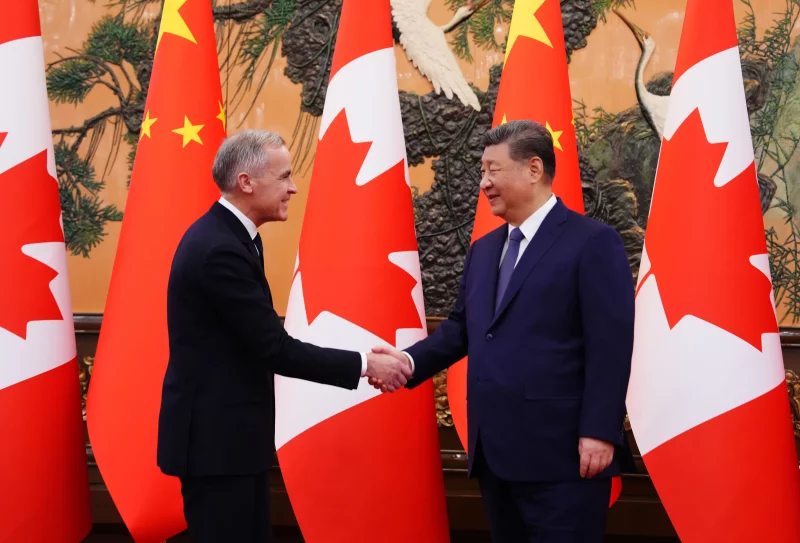
Canada has agreed to significantly reduce its tariff barrier on Chinese electric vehicles, marking a notable shift in trade policy as Ottawa seeks to rebalance its global economic relationships. The decision follows high-level discussions in Beijing and introduces a controlled quota system that will gradually allow more Chinese-made EVs into the Canadian market while easing access for Canadian agricultural exports.
Under the agreement, Chinese electric vehicle imports will be capped initially at 49,000 units, expanding to 70,000 vehicles over a five-year period. In parallel, China will sharply reduce tariffs on key Canadian farm products, most notably canola seeds, restoring access to a market that had been largely closed by punitive duties.
Trade Realignment and Strategic Autonomy
The move reflects Canada’s effort to diversify trade partnerships at a time of heightened global uncertainty and persistent tariff pressures. By easing restrictions on Chinese EVs, Canada is signaling a willingness to pursue a more autonomous trade strategy, even when it diverges from policies adopted by Washington.
Officials involved in the negotiations emphasized that the agreement is designed to balance domestic industrial concerns with export competitiveness. According to trade frameworks outlined by the Government of Canada, agricultural exports remain a cornerstone of national economic stability, particularly amid disruptions affecting North American supply chains.
China’s decision to lower its tariff on Canadian canola seeds from approximately 84% to about 15% represents a substantial shift, potentially reopening a multibillion-dollar export channel that had seen volumes collapse in recent years.
Electric Vehicles, Agriculture, and Market Access
The quota-based approach to EV imports is intended to prevent sudden market saturation while still allowing Canadian consumers access to lower-cost electric vehicles. The policy also aligns with Canada’s long-term emissions goals by accelerating EV adoption without requiring immediate large-scale domestic production increases.
Chinese regulators, operating under guidelines from the Ministry of Commerce of the People’s Republic of China, have framed the agreement as a step toward stabilizing bilateral trade and encouraging predictable market conditions. Agricultural exporters in Canada are expected to benefit first, particularly those tied to oilseeds and processed farm goods.
China had previously imposed a combination of tariffs exceeding 75% on Canadian canola products, alongside additional duties on pork and seafood. Those measures effectively restricted Canadian access to one of its most important overseas markets, contributing to a decline in bilateral trade volumes to $41.7 billion last year.
Global Trade Implications and Economic Outlook
The agreement carries broader implications for global trade governance, particularly as middle powers navigate an environment shaped by protectionism and shifting alliances. Canada’s decision underscores a growing emphasis on pragmatic bilateral arrangements rather than rigid alignment within traditional blocs.
Trade analysts note that the framework remains consistent with obligations under the World Trade Organization, as it applies transparent quotas and reciprocal tariff reductions rather than outright market exclusion. This structure may serve as a template for future sector-specific agreements involving clean technology and food security.
Looking ahead, Canadian officials are expected to promote the deal to international investors and policymakers during upcoming global forums, including discussions linked to the World Economic Forum, where trade resilience and supply-chain diversification remain high on the agenda.
As electric vehicles and agricultural commodities become increasingly central to economic diplomacy, the Canada–China tariff agreement highlights how targeted concessions can reshape trade flows while preserving national strategic priorities.