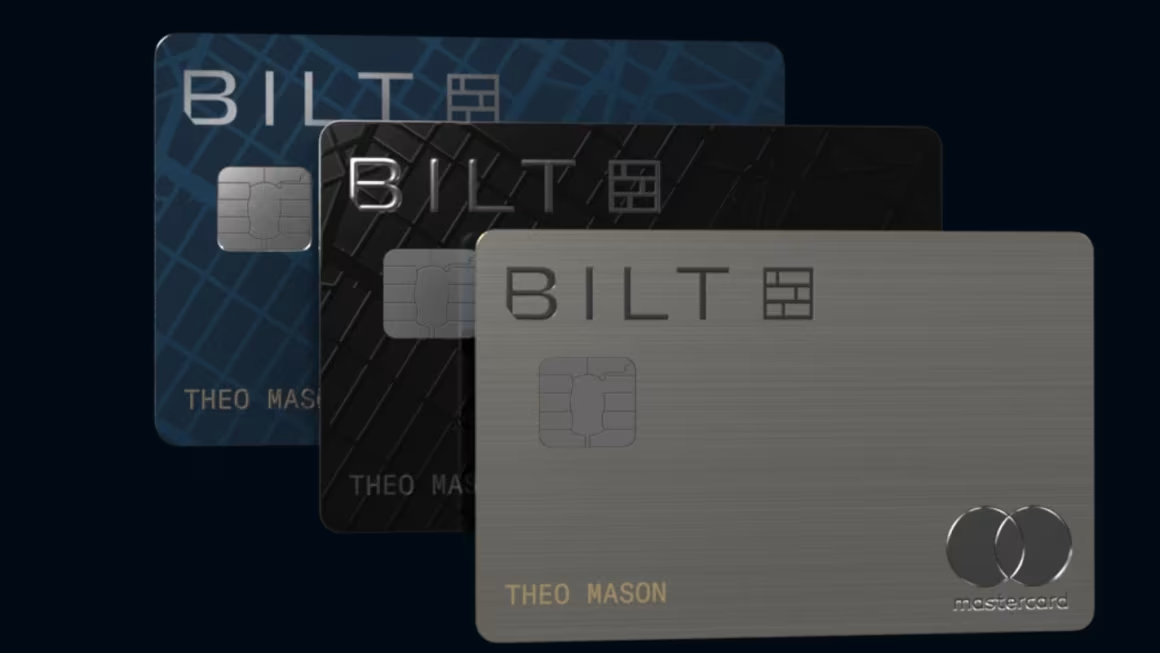
Bilt Rewards entered the market in 2021 with a compelling promise: earn transferable loyalty points on rent payments, one of the largest monthly expenses for many Americans. That simple value proposition helped the program stand out in a crowded credit card landscape. Now, with the launch of three redesigned credit cards, Bilt is broadening its reach to include mortgage payments—but at the cost of introducing a far more intricate rewards structure.
While the opportunity to earn rewards on housing remains rare among issuers, the new system demands more decision-making and financial tracking than before. For everyday consumers who prefer straightforward earning and redemption, the added layers may feel overwhelming rather than empowering.
A Shift From Simplicity to Strategy
Under the original structure, users needed only to make five transactions per month to unlock one point per dollar on rent, with no transaction fee. The updated system requires cardholders to choose between earning Bilt Cash or participating in a tiered points model that ties housing rewards to non-housing spending levels.
The new lineup includes the Bilt Blue Card with no annual fee, the Bilt Obsidian Card with a $95 annual fee, and the Bilt Palladium Card with a $495 annual fee. Details about the program and its mechanics are outlined on the Bilt Rewards platform, where members manage their accounts and track earnings.
Bilt Cash functions like a parallel currency. Cardholders earn 4% Bilt Cash on non-housing purchases and can redeem it for select services within Bilt’s partner network. However, Bilt Cash expires at year’s end, with only up to $100 eligible for rollover. By contrast, Bilt Points do not expire and can be transferred to airline and hotel partners.
For those choosing the tiered system, the earning rate on rent or mortgage depends on how much is spent elsewhere on the card. If non-housing purchases equal 100% of the monthly housing payment, users can earn up to 1.25 points per dollar. Falling short reduces the return. That formula introduces ongoing calculations that many competing cards simply do not require.
Comparing the Three New Cards
The no-fee Bilt Blue Card appeals to renters or homeowners seeking rewards without an annual cost. It offers one point per dollar on non-housing purchases and up to 1.25 points per dollar on housing under the tiered system. While light on perks, it avoids foreign transaction fees and provides cell phone protection when the bill is paid with the card.
The mid-tier Obsidian Card, priced at $95 annually, offers elevated rewards in either dining or groceries, selectable each year. It also includes limited hotel credits and travel protections. The Palladium Card, at $495 annually, targets frequent travelers with double points on non-housing purchases and a lounge membership through Priority Pass, which independently costs $469 per year without guest privileges.
Points earned through Bilt can be transferred to travel partners such as Hyatt Hotels, adding flexibility for those who understand airline and hotel loyalty ecosystems. That transferability contributes to the program’s perceived value, but it also reinforces the idea that maximizing rewards requires active engagement and planning.
The Palladium card’s introductory offer advertises 50,000 points after $4,000 in qualifying spending within three months. Based on some industry valuations, that bonus could represent roughly $1,100 in potential travel value, more than double the $495 annual fee. Still, realizing that value depends on savvy redemption strategies rather than simple cash-back redemptions.
Alternatives for Simpler Rewards
For consumers who find Bilt’s dual-currency system and tiered thresholds confusing, other travel cards provide flat-rate earning without constant recalculations. One example frequently compared in the premium segment is the Capital One Venture X Rewards Credit Card, which charges a $395 annual fee and earns a consistent 2x miles on most purchases.
Flat-rate cash-back cards may be even easier to manage. Instead of tracking spending ratios to optimize rent rewards, users can earn predictable returns on everyday purchases. The trade-off is that these alternatives typically do not offer rewards on rent or mortgage payments.
Bilt’s evolution reflects a broader trend in financial products: expanding features while increasing complexity. The addition of mortgage eligibility broadens its market reach, yet the layered structure demands attention to thresholds, expiration dates and redemption rules. For enthusiasts who enjoy optimizing points, that may be part of the appeal. For others, the cognitive load could outweigh the incremental rewards.