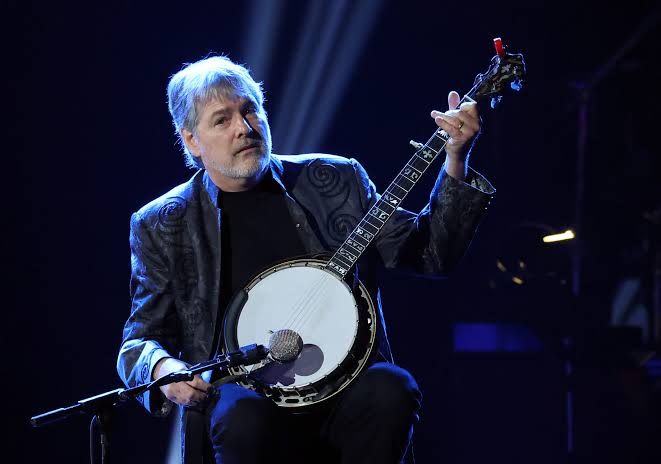
Béla Fleck, the internationally acclaimed banjo virtuoso and 18-time Grammy Award winner, has withdrawn from three upcoming performances scheduled with the National Symphony Orchestra at the John F. Kennedy Center for the Performing Arts. The concerts, planned for next month, were part of Fleck’s ongoing collaborations with symphony orchestras across the United States, a practice that has long defined his genre-crossing career and commitment to musical experimentation. His decision places him among a growing number of artists who have stepped away from engagements at the Washington, D.C.-based cultural institution amid major administrative and curatorial changes.
Fleck announced his decision through a public statement shared on social media, explaining that the atmosphere surrounding performances at the Kennedy Center has become increasingly politicized. According to Fleck, the shift detracts from the core mission of live music and artistic expression. The banjo player emphasized that his intention was not to disengage permanently from the institution or from the National Symphony Orchestra, whose work he has praised in the past, but rather to step back until conditions allow for a renewed focus on art rather than ideology.
A career rooted in musical collaboration
Over several decades, Fleck has built a reputation as one of the most innovative figures in contemporary American music. His work spans bluegrass, jazz, classical, and world music traditions, often bringing the banjo into settings where it is rarely heard. Through projects such as the Flecktones and collaborations with orchestras nationwide, Fleck has consistently blurred genre boundaries while maintaining a strong commitment to musical dialogue. More information about his career and projects can be found on his official website at https://www.belafleck.com.
His collaboration with symphony orchestras, including the National Symphony Orchestra, reflects a broader trend of integrating nontraditional instruments into classical performance spaces. The NSO, which is resident at the Kennedy Center, has played a central role in these cross-genre efforts, as outlined on its institutional page at https://www.kennedy-center.org/nso. Fleck’s cancellation therefore represents not only a personal decision but also a disruption to a broader artistic exchange that has drawn diverse audiences.
Institutional changes at the Kennedy Center
The Kennedy Center has experienced significant structural and leadership changes over the past year, transforming its public image and internal governance. As detailed on the center’s official site at https://www.kennedy-center.org, the institution traditionally positions itself as a nonpartisan space dedicated to celebrating the performing arts. Recent developments, however, have sparked debate among artists, audiences, and cultural organizations regarding the balance between artistic independence and political influence.
These changes have coincided with a series of high-profile withdrawals by musicians, composers, and performance groups who have expressed concern about the evolving environment. The pattern of cancellations has drawn attention to how governance decisions at major cultural institutions can influence artistic participation and public perception, particularly when those institutions serve as national symbols.
Broader implications for artists and audiences
Fleck’s decision underscores a wider conversation within the arts community about the role of major performance venues in an increasingly polarized cultural landscape. Artists often rely on institutions like the Kennedy Center to provide neutral platforms where creativity can flourish without external pressures. When that neutrality is questioned, performers may reassess how and where they present their work.
The debate also raises questions about audience access and inclusivity. While the Kennedy Center continues to host a wide range of performances, the withdrawal of prominent artists can alter programming and affect public engagement. Organizations such as the Recording Academy, which oversees the Grammy Awards and recognizes artistic excellence across genres, frequently highlight the importance of creative freedom in sustaining a vibrant cultural ecosystem, as reflected on https://www.grammy.com. Fleck’s stance aligns with this principle, emphasizing music as a unifying force rather than a political statement.