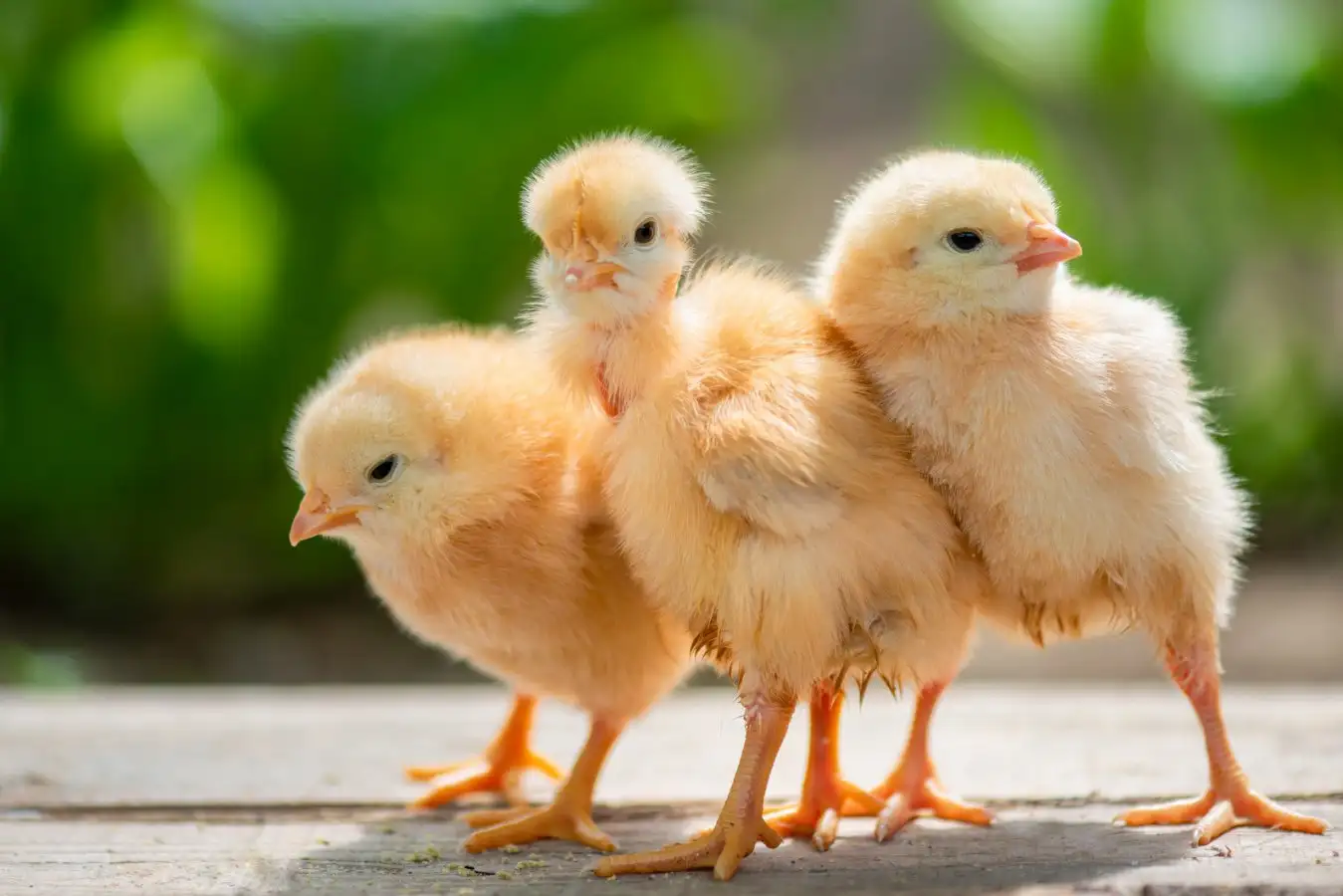
Baby chicks can associate sounds with shapes in a way strikingly similar to humans, according to new research that sheds light on the biological roots of language. The findings suggest that the well-known “bouba-kiki effect” — a cognitive bias where soft sounds are linked with round shapes and sharp sounds with spiky forms — may extend far beyond humans and primates, potentially reaching deep into evolutionary history.
The experiments, published in the journal Science, indicate that even animals with vastly different brains from ours share basic sensory associations. This discovery is fueling new debates about how language may have evolved and whether some building blocks of communication are hardwired across species.
Experiments reveal innate sound-shape associations
The bouba-kiki effect has fascinated scientists for decades. In humans, people across cultures consistently match the nonsense word “bouba” with rounded shapes and “kiki” with jagged ones. Even infants just a few months old display this preference, suggesting that the phenomenon is not learned but innate.
Researchers recently explored whether similar patterns exist in animals by testing newly hatched chicks. Because chickens can be studied at extremely early developmental stages, they provide a rare opportunity to examine whether sensory associations emerge without cultural influence or learning.
In one experiment, three-day-old chicks were trained to associate food with panels displaying mixed shapes that combined rounded and spiky elements. Once trained, the birds were presented with separate rounded and jagged shapes while recordings of “bouba” or “kiki” played repeatedly. The chicks showed a consistent preference: they approached rounded shapes when hearing “bouba” and spiky shapes when hearing “kiki.”
The study builds on a growing body of work examining how animals perceive sound symbolism and cross-modal associations, which you can explore further in cognitive science resources like https://www.science.org and https://www.nature.com.
Testing chicks at the earliest stages of life
To determine whether experience played any role, researchers conducted additional trials with chicks only one day old. At that age, chicks naturally gravitate toward visually engaging moving objects. Scientists displayed animated rounded and jagged shapes on screens while playing the same sounds.
The results were consistent: chicks approached spiky shapes when hearing “kiki” and rounded ones when hearing “bouba.” Because the birds had virtually no time to learn from their environment, the findings strongly suggest that the association is innate rather than learned behavior.
This approach has implications for understanding perception in animals more broadly. Studies on animal cognition from institutions such as https://www.apa.org and https://www.cell.com increasingly show that many species share sensory patterns once thought uniquely human.
What it means for the origins of language
The discovery raises intriguing questions about the evolution of language. Scientists have long wondered how humans developed the ability to create shared symbols and sounds with meaning. If sound-shape associations are widespread across species, they may have served as a biological foundation for early communication systems.
Previous attempts to detect the bouba-kiki effect in great apes yielded mixed results, making the chick findings even more surprising. The results suggest that the roots of these sensory links may trace back to a distant common ancestor shared by birds and mammals.
Researchers emphasize that chicks do not possess language. However, they appear to share fundamental perceptual linkages that humans later expanded into complex symbolic systems. These sensory correspondences may represent a basic “scaffold” that made it easier for early humans to develop spoken language and symbolic thought.
Scientists are now exploring whether similar patterns exist across other animals and sensory domains. For example, some research indicates that high-pitched sounds are often associated with small or light objects, while lower tones correspond to larger or darker ones. Such cross-modal mappings could represent universal features of vertebrate brains.
Ultimately, the findings highlight what makes humans unique: the ability to build on basic sensory links and create entirely new symbolic systems. While animals may share the perceptual groundwork, humans have developed an extraordinary capacity to generate meaning through sound, gesture, and imagery — a defining trait that continues to shape language, culture, and cognition.