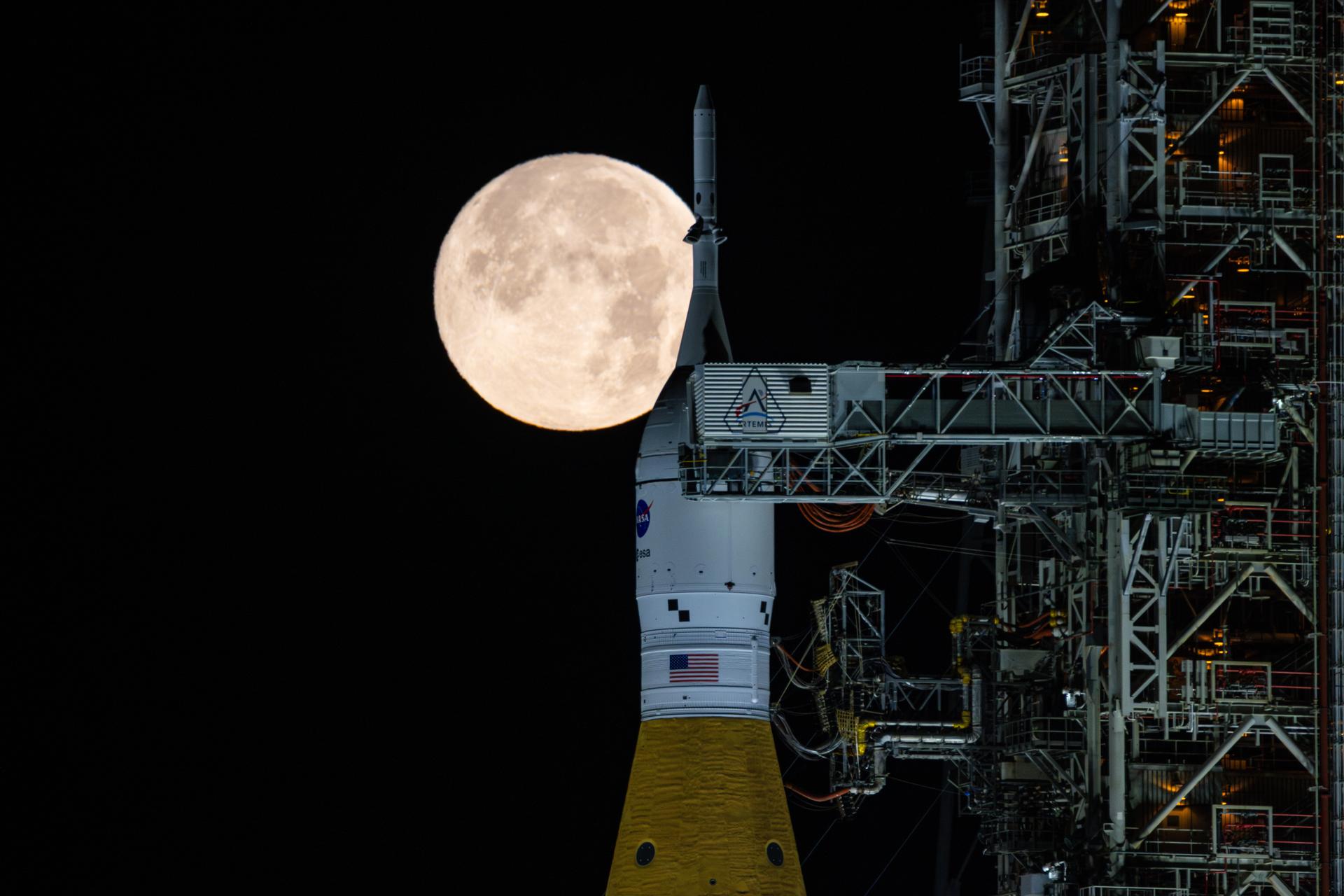
NASA has begun a decisive phase in its preparations for the Artemis II mission, launching the highly anticipated wet dress rehearsal that will test the full fueling and countdown process for the Space Launch System rocket and the Orion spacecraft. This critical operation represents one of the most complex prelaunch procedures in modern space exploration, serving as a full-scale simulation of launch day conditions. The objective is to validate every technical and operational step before astronauts are cleared for their historic journey around the Moon, reinforcing the broader goals of the Artemis program to establish a long-term human presence beyond Earth orbit.
The wet dress rehearsal comes after weeks of intense preparation at NASA’s Kennedy Space Center in Florida, where teams have carefully configured the launch vehicle and spacecraft for cryogenic fueling. The procedure involves loading more than 700,000 gallons of liquid oxygen and liquid hydrogen into the rocket’s massive propellant tanks, followed by a meticulously timed countdown sequence. This test not only evaluates fueling systems but also confirms communication links, electrical performance, and emergency protocols, ensuring that every subsystem operates flawlessly under real launch conditions. These efforts support NASA’s long-term strategy for deep-space exploration, which also includes collaboration with international partners and private industry through platforms such as https://www.nasa.gov and https://www.spacex.com.
Critical Testing of the Orion Spacecraft and SLS Rocket
During the wet dress rehearsal, engineers follow a detailed countdown timeline designed to replicate launch day operations as closely as possible. This includes initiating the countdown clock, transitioning the spacecraft and rocket through multiple readiness checkpoints, and rehearsing contingency procedures. The Orion spacecraft, which will carry four astronauts on their 10-day journey, remains powered and monitored continuously as teams prepare to charge its flight batteries and conduct final systems verifications. These steps are essential to validate life-support systems, navigation instruments, and onboard computing platforms that must function flawlessly once the crew is aboard.
The fueling process is especially complex due to the extremely low temperatures required to store liquid oxygen and hydrogen. Managing these cryogenic fluids demands absolute precision, as even minor fluctuations in temperature or pressure can affect performance. Engineers also conduct controlled detanking operations to confirm that propellants can be safely removed if a launch attempt must be postponed. These practices provide invaluable data that strengthens confidence in the vehicle’s readiness and supports NASA’s commitment to safety, reliability, and mission success, reinforcing objectives shared with partners such as the European Space Agency at https://www.esa.int.
Artemis II and the Return of Human Lunar Exploration
Artemis II will be the first crewed lunar mission in more than half a century, carrying four astronauts on a trajectory that loops around the Moon before returning to Earth. The mission serves as a pivotal milestone in NASA’s broader campaign to establish a sustained presence on and around the lunar surface. By validating spacecraft systems and mission operations in deep space, Artemis II will lay the groundwork for future landings and long-duration stays, advancing scientific discovery and technological innovation.
Beyond its symbolic significance, Artemis II is strategically designed to test navigation, communications, and human performance in deep space. The mission will gather data on radiation exposure, life-support reliability, and long-duration flight operations, all of which are essential for future expeditions to Mars. NASA’s integrated exploration roadmap emphasizes collaboration across government, industry, and academia, building upon decades of research documented through platforms like https://www.jpl.nasa.gov. These combined efforts aim to unlock new frontiers in planetary science, resource utilization, and human exploration.
Astronaut Preparation and Final Launch Readiness
Although astronauts will not participate directly in the wet dress rehearsal, their preparation continues in parallel. The Artemis II crew remains in controlled quarantine to minimize health risks ahead of launch, following strict protocols that limit outside exposure. This period allows astronauts to focus on mission simulations, emergency response training, and spacecraft operations, ensuring peak readiness for flight. As launch day approaches, the crew will relocate to dedicated astronaut quarters at Kennedy Space Center, where final briefings and system checks will take place.
Once the wet dress rehearsal concludes successfully, NASA will review the extensive data collected during fueling, countdown, and detanking operations. Engineers will analyze system performance, identify potential refinements, and implement any necessary adjustments before final launch approval. This comprehensive approach underscores NASA’s methodical strategy, prioritizing safety and precision while advancing ambitious exploration goals. With Artemis II, humanity stands on the threshold of a new era of lunar exploration, one that combines cutting-edge technology, international collaboration, and a renewed commitment to pushing the boundaries of what is possible in space.