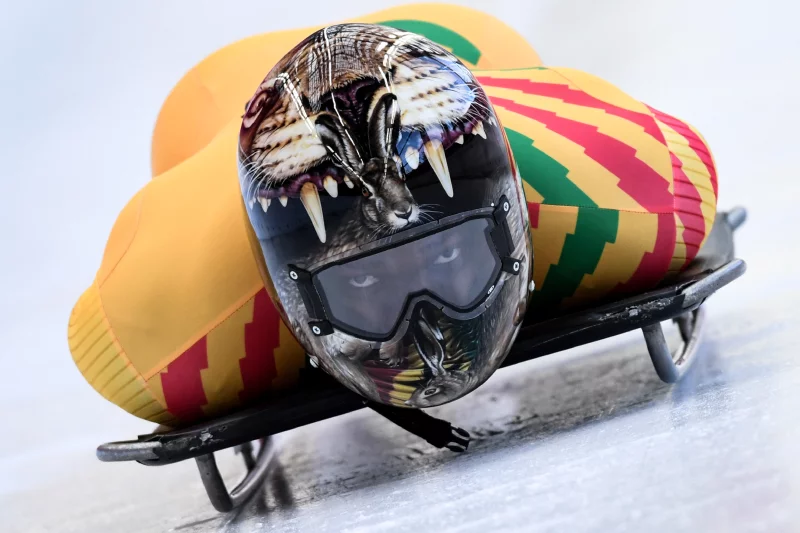
Akwasi Frimpong often describes skeleton in the simplest possible way: you sprint, dive onto what feels like a baking tray with blades, and hurtle headfirst down an icy track at highway speeds. “Dude, good luck,” he jokes — a line that perfectly captures both the absurdity and courage the sport demands. Yet behind the humor lies a journey defined by persistence, reinvention, and a relentless belief in possibility.
Born in Ghana and raised in the Netherlands after moving there as a child, Frimpong’s path to elite winter sport was anything but conventional. Long before he discovered skeleton, he dreamed of becoming an Olympian on the track. That dream would evolve across continents and disciplines before finally becoming reality on the ice.
From Track Dreams to Ice Tracks
Frimpong’s athletic journey began in sprinting. As a teenager in the Netherlands, he was recruited by a coach who believed his speed could take him to the Summer Olympics. That belief fueled years of disciplined training, eventually earning him a spot on the Dutch pre-Olympic 4×100 relay squad ahead of the 2012 Games. A tendon injury, however, ended his immediate hopes.
His raw speed opened another door: bobsled. Recruited as a brakeman for the Dutch team, he trained for the 2014 Winter Games but narrowly missed selection. For a second time, the Olympic dream slipped away.
Determined not to let opportunity define his limits, Frimpong pivoted once more — this time to skeleton. Unlike bobsled, skeleton is a solo pursuit governed internationally by the International Bobsleigh & Skeleton Federation. Athletes sprint for a short distance before diving headfirst onto a small sled, steering with subtle body shifts while racing down tracks that can exceed 80 miles per hour.
The first runs were terrifying. But fear, Frimpong learned, could become fuel. “You have to embrace it,” he has said, describing how mental control becomes as vital as physical strength. With only 17 sliding tracks worldwide approved for international competition, according to standards maintained by the International Olympic Committee, access and funding quickly became his biggest obstacles.
Representing Ghana on the Olympic Stage
Frimpong faced a pivotal choice: compete for the Netherlands, where resources were more accessible, or represent Ghana, the country of his birth. He chose Ghana, determined to broaden the narrative of who belongs in winter sport.
In 2018, he made history as the first Black male African skeleton athlete to compete at the Winter Olympics. That same year, Simidele Adeagbo represented Nigeria, further expanding African visibility on the ice. Frimpong’s presence symbolized more than personal triumph — it was a message to over 1.4 billion people across Africa that participation in winter sport was possible.
Training as a Ghanaian athlete required constant travel, often to facilities in North America and Europe. Park City, Utah, became a critical base, with competitions sanctioned through USA Bobsled/Skeleton. Financial strain was constant. Sponsorship, equipment upgrades, and international travel demanded resources that could easily surpass $50,000 per season.
Even so, Frimpong steadily improved, competing in multiple World Championships and becoming the first African athlete to win an elite skeleton race in Park City. His competitive record proved he was not merely symbolic — he was serious.
Beyond Competition: Building Hope and Legacy
Frimpong continued racing beyond 2018 with his sights set on future Olympic qualification. The margins in skeleton are razor thin, often separated by hundredths of a second. Equipment precision can cost thousands of dollars, and as competition intensified globally, qualification became increasingly difficult.
When he ultimately fell short of making the 2026 Games, disappointment was tempered by perspective. Shortly afterward, he required emergency surgery for a ruptured appendix — a reminder that life sometimes redirects ambition for reasons unseen.
Today, Frimpong’s focus extends beyond the starting line. Through his foundation, Hope of a Billion, he and his wife travel internationally to mentor young people, encouraging resilience, discipline, and self-belief. The organization partners with schools and community initiatives aligned with youth development goals supported by institutions such as United Nations programs focused on education and empowerment.
Turning 40 marked the symbolic close of his competitive chapter. While he may occasionally return to the track for the thrill of it, his larger mission now lies in mentorship — helping athletes from underrepresented nations navigate sports long dominated by wealthier countries.
Frimpong’s story demonstrates that Olympic dreams are rarely linear. They twist, stall, accelerate, and sometimes change form entirely. What endures is the conviction that stepping outside one’s comfort zone can redefine both personal destiny and collective imagination.